
Trend lists are usually where marketing writing goes to waffle. So we set one rule for this piece: every video marketing trend on it has to show up in the money, the behaviour or the platforms, with a named source attached. Not a vibe, a number. What follows are the seven video marketing trends we would genuinely plan around for 2026, and what we think you should do about each one. If you want the raw figures instead, our video marketing statistics for 2026 hub collects more than 50 sourced numbers in one place. This piece is about what those numbers are trying to tell you.
Short-form video is still the trend that pays
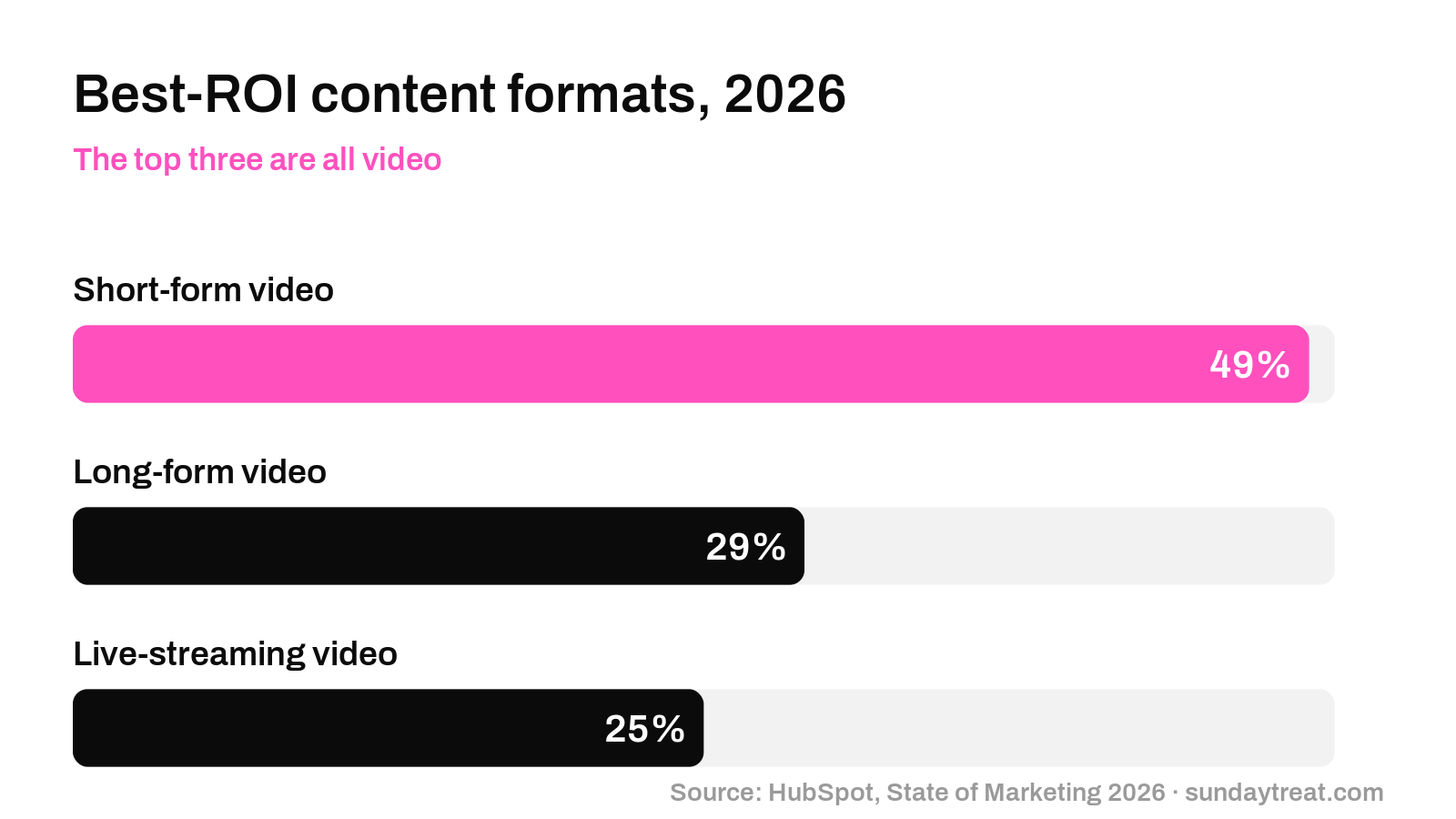
Short-form video is the highest-returning format in marketing for another year running. 49% of marketers name it their best ROI format, and the top three ROI formats in 2026 are all video: short-form, long-form, then live (HubSpot, State of Marketing 2026). TikTok, the format’s home turf, has passed 3.5 billion monthly active users (Sofina / ByteDance, 2026).
Most short form video trends collapse into one word this year: maturity. The average TikTok video has crept up to 42.7 seconds (Statista / Metricool), feeds are saturated with sameness, and the easy reach of 2022 is gone. When everyone is posting short-form, posting short-form is not a strategy. Making it properly for the platform it lands on is. A vertical edit with a native hook behaves completely differently from a squashed TV ad, and audiences can smell the difference in about half a second.
The budget signal backs the behaviour: 92% of marketers who spent on video ads plan to spend the same or more in 2026 (Wyzowl, 2026). So the practical move is not to post more, it is to raise the floor. Fewer ideas, each built properly for the feed it will live in, each opened with a hook that would survive a stranger’s thumb. That discipline is worth more this year than any volume target, because the feed does not reward presence anymore. It rewards being the best thing in it for eight seconds.
For 15 years now, video has been one of the most effective methods to communicate to audiences online, and its popularity is increasing across every platform every year.
 Gulliver Moore
Co-Founder, Sunday Treat
AI has moved from the edit suite into production
AI stopped being an experiment and became part of the pipeline: 63% of video marketers used AI tools to create or edit video in 2026, up from 51% a year earlier (Wyzowl, 2026). And 2025 was the year the biggest advertisers went public with it.
Coca-Cola’s holiday campaign was made by a team of roughly 100 people working through more than 70,000 AI-generated clips (reported by Forbes, 2025). Adland argued about it loudly, but System1’s testing found the ad still landed emotionally with ordinary viewers (System1, 2025). Netflix, meanwhile, put generative AI footage into a finished series for the first time, a collapsing building in El Eternauta that co-CEO Ted Sarandos said was completed ten times faster than traditional VFX would have allowed (2025).
The AI video trends worth acting on are workflow trends, not demo reels. Our position has not moved: AI earns its keep in the invisible parts, the drafts, the variations, the rescue jobs on brutal deadlines. The moment the audience can tell a machine made the thing, the thing stops working. We wrote more about where the line sits in our piece on the future of AI in animation.
The Coca-Cola episode is the whole trend in miniature. The efficiency was real, the ad tested fine, and the loudest reaction was still discomfort, because audiences were told the machine made it. Which suggests the winning play for most brands in 2026 is quieter: AI in the previs, the rough cuts, the localisations and the cleanup, and human hands on everything the viewer actually feels. Speed where it is invisible, craft where it is not.
Budgets are moving to creator-led media
US brands will spend 12.2 billion dollars on influencer marketing in 2026, and total US creator-economy revenue is heading past 21 billion dollars, more than double what it was in 2022 (eMarketer, 2026). That is no longer a test budget. It is a media channel.
The sharpest detail sits underneath: nano and micro creators now take 49.9% of US creator spend, up from less than a fifth a few years ago (eMarketer, 2026). Brands have worked out that relatability converts harder than reach. It is the same logic driving the rise of user-generated content: trust has become the scarce asset, and real people carry it better than ad units do.
We see the volume side of this daily. One Revolut campaign with Grace Beverley produced 50 deliverables from a single production, which is what creator-led output looks like when it is planned properly. If you are building a creator programme rather than buying one-off posts, that is exactly what our influencer marketing team does.
Social platforms are doing search’s job
Search behaviour has genuinely shifted: 49% of consumers have used TikTok as a search engine, up eight points in a single year (Adobe, 2025), and eMarketer reported in 2025 that social has overtaken search engines for product discovery among Gen Z and millennials.
Of all the social video trends in this piece, this is the one most brands still treat as a rumour. The practical consequence is that your videos are now search results. Which means the boring disciplines suddenly matter on social: say the query out loud in the opening seconds, put it in the on-screen text and the caption, and answer it properly. The comments section doubles as free keyword research, because people type exactly what they could not find. Treat every social video as something a stranger should be able to discover next month, not just something followers scroll past today.
One honest nuance: this is a both-and shift, not a replacement. Gen Z’s stated preference for TikTok over Google actually halved between 2024 and 2026, from 8% to 4% (Search Engine Journal, 2026). People still go to Google for the serious stuff. What has changed is the discovery layer, the “what should I buy, try, watch, book” questions, and Adobe’s data says people pick TikTok for exactly the reasons ads struggle there: the short video format (26%) and the storytelling (21%). Make videos that answer discovery questions well and you win the moment that matters most in a purchase.
AI answers quote video, and it is almost always YouTube
When Google’s AI Overviews cite a source, 29.5% of the time it is YouTube, the most-cited domain of all, based on BrightEdge’s analysis of 36 million AI answers (2025). Across AI platforms, YouTube gets around 200 times more citations than any other video platform.
This is the video-shaped edge of the zero-click shift we covered in the future of content marketing: more questions get answered without a website visit, and the engines doing the answering lean heavily on video for how-to, demo, review and pricing queries. If your brand has no video that directly answers the questions your buyers ask, you are invisible in a growing slice of search. The fix is unglamorous and effective: make answer-shaped videos, use clear titles and chapters, and let the transcript carry the language people actually search with.
The TV screen is video marketing’s fastest-growing channel
US connected TV ad spend will reach 37.95 billion dollars in 2026, up 14.5% year on year, on its way to a forecast 51 billion by 2029 (eMarketer, December 2025). And in 2026, for the first time, CTV upfront spend overtakes primetime linear upfront spend, 17.73 billion dollars against 16.98 (eMarketer, 2026).
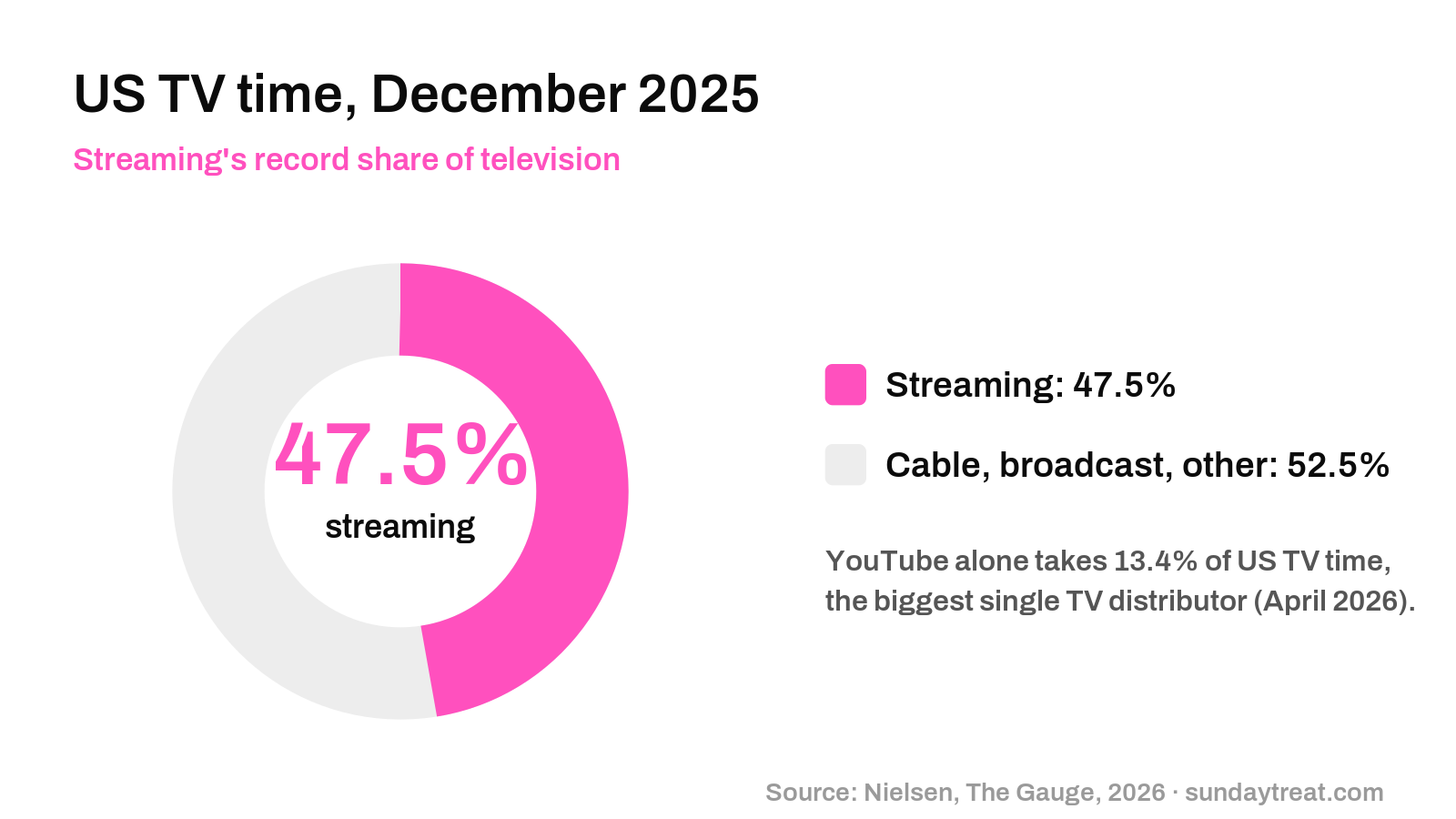
The audience got there first. Streaming took a record 47.5% of all US TV time in December 2025, and YouTube alone is the single biggest distributor of television in America at 13.4% of TV watch time (Nielsen, The Gauge, 2026). The scroll has moved to the sofa. And it sits inside a bigger migration of money: digital video takes 61% of all US TV and video ad spend in 2026, some 81.9 billion dollars (IAB / eMarketer, 2026).
For brands this cuts both ways. Social-first teams suddenly need work that holds up on a 55-inch screen, and TV-first teams need to buy like performance marketers, because CTV is bought, measured and optimised like digital. Sitting between those two worlds is precisely where our performance marketing team earns its keep.
Podcasts quietly became a video format
More than 1 billion people now watch podcast content on YouTube every month (YouTube, 2025). Watch, not listen: viewers put 700 million hours of podcasts through living-room TV screens in October 2025 alone, up from 400 million a year earlier (YouTube, 2025). Among weekly US podcast listeners, 31% name YouTube their preferred service, ahead of Spotify on 27% and Apple Podcasts on 15% (YouTube / Edison Research, 2025).
That makes the podcast a video product now, with thumbnails, framing, cutdowns and clips that feed the short-form machine. For brands, it is the cheapest route into long-form trust that currently exists: a founder or expert show, filmed properly once, becomes hours of watch time plus a month of clips. The brands that treat podcasts as content systems rather than audio side projects are getting both ends of the funnel from one recording session.
What the 2026 video marketing trends mean for your plan
Put the seven together and one theme falls out: distribution has changed faster than most brands’ production habits. Attention now lives in short vertical feeds, AI answer boxes and 55-inch streaming screens, and it is earned by creators and formats that feel human, not by whichever brand exports the most files.
Most video trends 2026 roundups end by telling you to chase everything at once. Do not. Pick the two or three shifts that touch your audience hardest and resource them properly, rather than sprinkling budget across all seven. Make the work platform-native from the brief onwards. Use AI where nobody can see it and people where everybody can. And keep score honestly, because every one of these trends rewards brands that measure what actually happened. If you want a starting point for the next quarter: audit whether your best content answers a real search query, get one piece of work onto a TV screen, and test one creator partnership properly instead of admiring the trend from a distance. That approach is how our own TikTok passed 50 million views in the first three months of 2026, and it is the thinking our creative strategy team brings to every plan we build. The platforms will keep shifting. The job stays the same: make something people choose to watch, wherever they are watching, and find the fun in it.
Want to get ahead of the shifts?
We are a London video and content agency, and a winner at The Drum Awards. If 2026 is the year your video plan grows up, let’s talk.
Get In Touch