
Most video marketing strategies are not strategies at all. They are production schedules wearing a strategy costume: a list of assets, a posting calendar, and a hopeful line about “engagement”. Then the videos go out, nothing much happens, and video quietly gets filed under “tried it”. The problem was never the video. It was the missing thinking before the video. This is the video marketing strategy framework we use at Sunday Treat on real campaigns for real brands, from the first objective to the measurement loop, and it starts with a decision most marketers get backwards: pick one channel and win it before you go anywhere else.
What a video marketing strategy actually is (and is not)
A video marketing strategy is the set of decisions you make before anything gets filmed: what the business needs video to achieve, who it has to reach, which platforms it will live on, what kind of creative will earn attention there, and how you will know whether it worked. Five decisions. Everything else, the scripts, the shoot days, the edits, the captions, flows from them.
What it is not: a content calendar. A calendar tells you when things go out. A video content strategy tells you why they exist. And it is not a wishlist of formats either (“we should do a brand film, and some TikToks, and a podcast”). Formats are answers. A strategy starts with questions.
The distinction matters commercially. When we run this process as a creative strategy engagement, the deliverable is not a deck that gets admired and archived. It is a working video marketing plan: objectives, audiences, channel roles, creative territories and a measurement sheet the whole team actually uses. That is also the honest test to apply to any content strategy agency you are considering: ask to see a strategy they wrote a year ago, then ask what changed because of it. If the answer is nothing, you were being sold a document, not a decision-making system.
Why bother? Because the numbers are absurd
Video is not a nice-to-have channel any more. It is the main event. Around 91% of businesses now use video as a marketing tool, and 82% of marketers say it delivers a good return on investment (Wyzowl, 2026). The audience is ahead of the brands, too: 84% of consumers say they want to see more video from brands this year (Wyzowl, 2026).
The money follows the eyeballs. US digital video ad spend reaches $81.9 billion in 2026, up 11% year on year, and digital video now takes 61% of all TV and video ad spend (IAB / eMarketer, 2026). People watch an average of 2.5 hours of YouTube and TikTok a day (DataReportal, 2026). If you want the full data picture, we keep a regularly updated roundup of video marketing statistics on exactly this.
So the question facing most marketing teams is not “should we do video”. It is “why is our video not doing anything”. And that is a strategy question.
The video strategy framework: five decisions in a loop
Our video strategy framework runs objectives, audience, channel, creative, measurement, in that order, and then loops. Measurement feeds the next round of objectives, and the whole thing compounds. It looks simple. The value is in refusing to skip steps, because every failed video programme we have ever been asked to rescue skipped at least one.
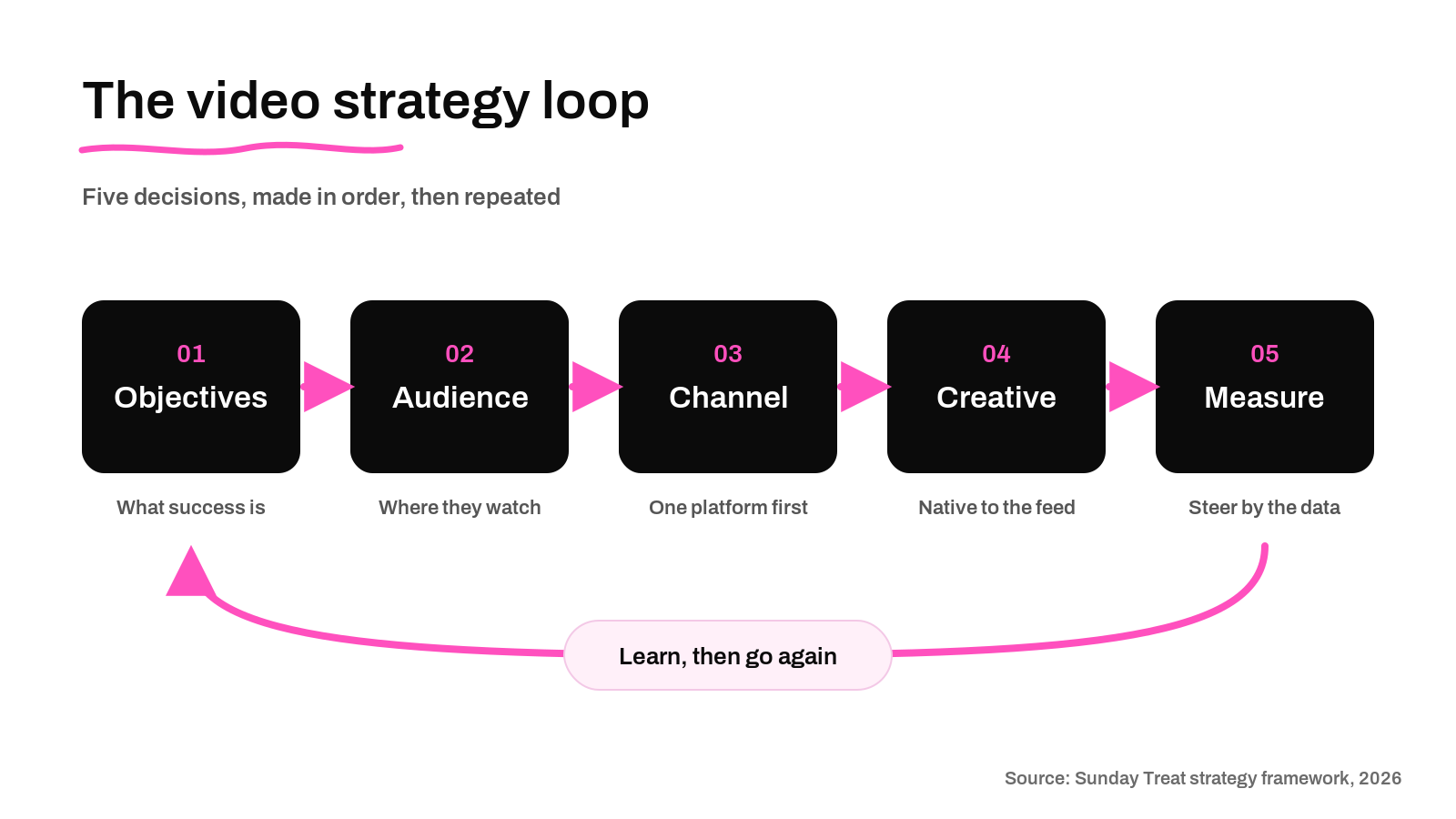
Notice what is not in the framework: formats, trends, tools. TikTok is not a strategy. Neither is “do more Reels”. Platforms and formats show up at stage three, once you know what you are trying to achieve and who for. Most video plans start at stage four (creative) and then wonder why stages one, two, three and five never happen.
Stage one: start with objectives, not formats
The first decision is what video is for, in plain commercial language. Awareness, where reach and watch-through are the numbers that count. Performance, where cost per acquisition decides everything. Or always-on brand building, where you are judged on engagement and audience growth over quarters rather than weeks. Each is a legitimate objective. Each produces a completely different plan, so choosing all three at once is choosing none of them.
The test we apply: can you finish the sentence “this quarter, video exists to…” without using the word “content”? If the honest answer is “because our competitors are doing it”, stop and go back. Weak objectives produce videos that look fine and achieve nothing, and nobody can even say what achieving something would have looked like.
Be honest about budget at this stage too. Real production budgets run anywhere from around 5,000 to 200,000 GBP depending on scale and ambition, and most brand work we see lands in a 10,000 to 40,000 GBP sweet spot. An objective without a budget attached is a wish.
Stage two: find out where your audience actually watches
Your audience has already decided where they spend their attention. Your only job is to catch up. In the UK, 94% of adult internet users are on YouTube, and viewing has climbed to 51 minutes a day (Ofcom, 2025). UK 18 to 34s put another 49 minutes a day into TikTok (Ofcom, 2025). In the US, 85% of adults use YouTube and roughly 90% of teens do (Pew Research Center, 2025). TikTok has passed 3.5 billion monthly active users worldwide (ByteDance / Sofina, 2026).
But averages hide the decision. A B2B software buyer and a 19-year-old sneakerhead are both “on YouTube”, and they will never see each other’s feeds. This is why the audience stage is research, not demographics-by-gut-feel: platform data, social listening, and honest time spent scrolling where your buyers scroll. For B2B brands the answer increasingly includes LinkedIn, which 8 in 10 B2B marketing teams now name as their primary place to share video (Wistia, State of Video 2026).
Short-form deserves a specific mention because it keeps winning: video under 60 seconds is the most-interacted-with format on most platforms (Sprout Social, 2026). Whatever channel you pick, you will need a short-form muscle.
Stage three: pick one foundational channel and nail it
Here is the part of our approach that surprises people: we do not recommend launching everywhere at once. Pick one foundational platform, the one where your audience research points hardest, and pour your energy into genuinely understanding it. Its pacing, its humour, its native formats, what its algorithm rewards. Win there first. Then, and only then, adapt what worked outwards to the other channels.
We practise this ourselves. Sunday Treat’s foundational platform is TikTok, and treating it that way took our own channel past 50 million views in the first three months of 2026. That did not come from posting everywhere. It came from focus: we keep TikToks planned two weeks ahead at all times, we study what the platform is rewarding this month, and we let the wins tell us what to remake for Instagram, Shorts and LinkedIn. We wrote up the mechanics of that approach in our guide to how to go viral on TikTok.
Why one channel first? Because platforms punish tourists. A video that flies on TikTok can die a quiet death on YouTube, and a polished 16:9 brand film dumped into a vertical feed reads as an ad within half a second. Spreading a small team across five platforms guarantees you are mediocre on all of them. Depth beats coverage until you have the wins to justify expanding, and when you do expand into paid distribution, the channel logic matters just as much (our TikTok advertising guide covers what changes when money enters the picture).
Channel-first does not mean channel-only forever. A mature channel strategy gives every platform a defined job once you expand: perhaps TikTok owns discovery, YouTube owns depth and proof, LinkedIn carries the B2B story, and email closes. The point is that those jobs get assigned deliberately, from evidence about where each part of your audience actually is, rather than defaulting to “post it everywhere and see”. Coverage without roles is how teams end up busy and invisible at the same time.
The channel-first rule: one foundational platform, nailed properly, will teach you more about your audience in three months than five platforms half-run will teach you in a year. Adapt outward from proof, not hope.
Stage four: make the creative for the platform, not the boardroom
Creative is where strategy either pays off or gets quietly abandoned. The discipline is making every asset for the platform it lives on: native aspect ratio, native pacing, a hook built for how people actually scroll there, captions designed for sound-off viewing where that is the norm. The campaign idea stays consistent. The execution changes shape every single time it changes home.
Gully has a strong view on where this goes wrong, and it is usually ego.
With creative strategy, people will get too hung up on a hero asset and how it’s going to perform just on the single social platform that is their priority.
 Gulliver Moore
Co-Founder, Sunday Treat
His fuller take: it is tempting for creative directors to think about their own showreel, to fall in love with one beautiful film, when the real job of a campaign is to hit the same person across many touchpoints in the format each one demands. A hero film has a role. But it is one player in a squad, not the squad.
Practically, that means planning the cutdowns, the hooks and the platform-specific versions at the strategy stage, not discovering in the edit that nothing works vertically. It is also why briefing one content production partner to shoot for every placement at once is cheaper than commissioning each format separately and hoping they match.
Stage five: measure what the objective needs, not what the platform shows you
Every platform dashboard is designed to make you feel good. Views, likes, impressions: numbers that go up. Your measurement sheet should mostly ignore them. Go back to stage one and measure the thing you said video was for. Awareness objectives get measured on reach, view-through and brand search lift. Performance objectives get measured on cost per acquisition and return on ad spend. Always-on gets measured on audience growth and engagement rate over quarters.
Two habits make measurement actually useful. First, decide the numbers before launch, so nobody is retro-fitting a success story afterwards. Second, close the loop: every month, let the data kill your weakest assumption and fund your strongest one. Measurement is not a report. It is the steering wheel. And when a video has proven it resonates organically, that is your cue to consider performance marketing and put spend behind a known winner rather than a guess.
One warning from experience: give the loop enough time to mean something. A single week of soft numbers is noise, and panicking at it produces the worst kind of strategy, the one that changes direction every fortnight. Read weekly, decide monthly, and only rewrite the strategy itself when a full quarter of evidence says the objective or the channel was wrong. Consistency is not stubbornness. It is how the data becomes trustworthy enough to act on.
Want a video strategy that earns its keep?
We are a London video and content agency, and a winner at The Drum Awards. We build channel-first video strategies and then make the work that proves them.
Get In TouchHow much video, how often: cadence and the production rhythm
A strategy that produces one video a quarter is a very expensive hobby. Feeds move fast, creative fatigues, and the platforms reward presence. The answer is not heroic effort. It is production rhythm: batching shoots so one day on set feeds weeks of output, planning content ahead (two weeks minimum, in our experience), and designing every shoot to produce families of assets rather than single films.
Volume and speed are both solvable with the right system. When Asda needed a reactive campaign, we turned around 16 assets in 10 days for the “Pop the Bublé” work. A single Revolut campaign with Grace Beverley produced 50 deliverables. Neither happened because anyone worked weekends. They happened because the strategy planned for volume from the first call: locations, formats and cutdowns mapped before the camera came out.

Where video strategies fall apart
After years of inheriting broken video programmes, the failure patterns are boringly consistent. Launching on every platform at once, so nothing gets learned anywhere. Obsessing over one hero asset while the feed-native work goes unmade. Copying a competitor’s format without their audience or their budget. Measuring views because views are easy, then wondering why the board is unimpressed. Quitting after six videos, right before the algorithm has enough signal to help you. And treating strategy as a one-off document rather than a loop that gets smarter every month.
None of these are creative failures. They are decision failures, which is genuinely good news, because decisions are cheaper to fix than reshoots.
Your first 90 days: a video marketing plan you can steal
Days 1 to 15: write the one-page strategy. One objective, one primary audience, one foundational channel, three creative territories, five numbers you will measure. Days 16 to 45: make and publish your first batch on that single channel, at least eight assets, so the data means something. Days 46 to 75: read the results honestly, kill the weakest territory, double down on whatever earned real watch time. Days 76 to 90: adapt your two best performers for a second platform, and brief the next batch using everything you now know.
That is the whole machine: objectives, audience, channel, creative, measurement, repeated until it compounds. It is not complicated. It is just rarely done, which is exactly why doing it is an advantage. And if you would rather run the loop with a team that has already made every mistake on this page so you do not have to, you know where we are. We will find the fun in it too, because that is rather the point.
