Video stopped being a “should we?” a long time ago. The only real question now is how well you do it. So we pulled together 50-plus of the most useful video marketing statistics for 2026, across the UK and US, and sourced every single one so you can quote it with confidence. These are the numbers we actually pay attention to.
One stat sets the tone for everything else: 89% of people say the quality of a video changes how much they trust the brand behind it (Wyzowl, 2026). In 2026, a cheap-looking video does not just underperform, it quietly costs you trust.
Last updated June 2026. Every figure names its source and year. If a number is useful to you, please link back to this page so readers can see the source and context. We refresh the data each January.
Video marketing adoption and ROI
The headline picture for 2026 is a mature market. Almost every business uses video, and most can point to a return, even if the all-time-high optimism of a couple of years ago has cooled a little.
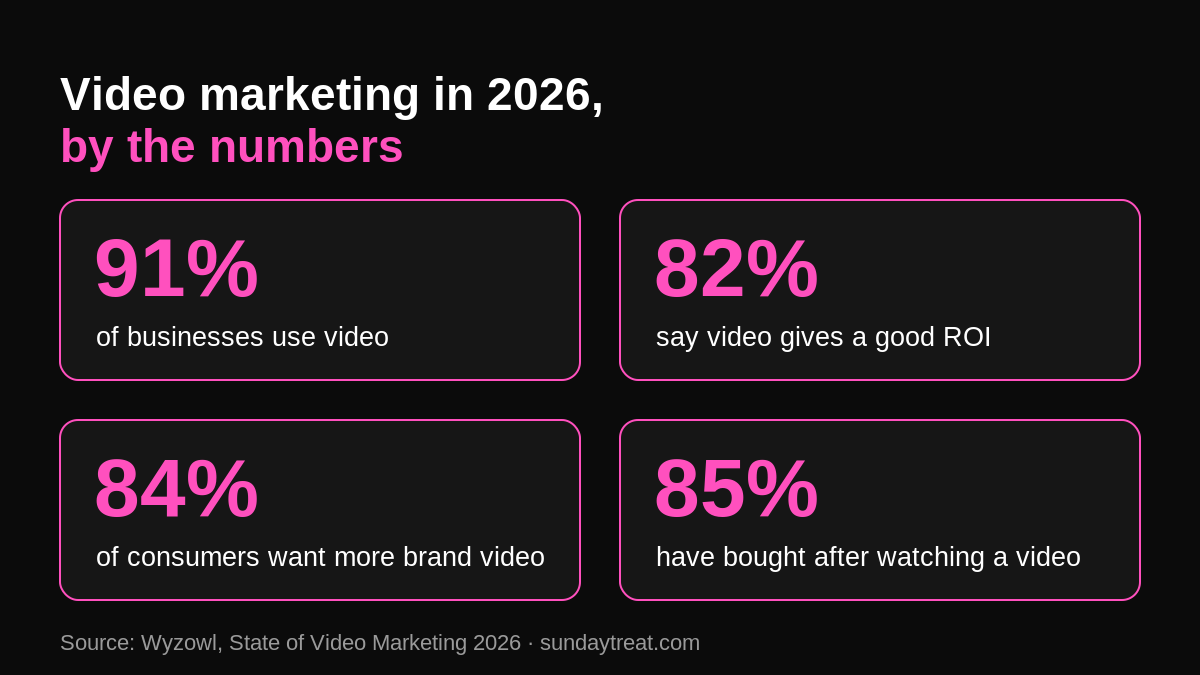
91% of businesses use video as a marketing tool in 2026, back to a joint all-time high after a small dip in 2025 (Wyzowl, 2026).
93% of marketers say video is an important part of their overall strategy (Wyzowl, 2026).
82% of marketers say video gives them a good ROI, down from a 93% high but still a strong majority (Wyzowl, 2026).
67% of marketers who do not yet use video plan to start in 2026 (Wyzowl, 2026).
37.1% of marketers plan to increase their video marketing investment in 2026 (HubSpot, 2026 State of Marketing Report).
What marketers say video does for them, across the funnel: 93% say it increased user understanding, 93% brand awareness, 85% lead generation, 83% direct sales, 82% web traffic and dwell time, and 57% say it reduced support queries (Wyzowl, 2026).
How consumers watch, learn and buy
This is the section that matters most when you are weighing up the spend. The demand side has been remarkably stable for years.
84% of consumers want to see more video from brands in 2026, a figure that has stayed within an 8-point band for eight straight years (Wyzowl, 2026).
85% of people say they have been convinced to buy a product or service by watching a video (Wyzowl, 2026).
96% of people have watched an explainer video to learn more about a product or service (Wyzowl, 2026).
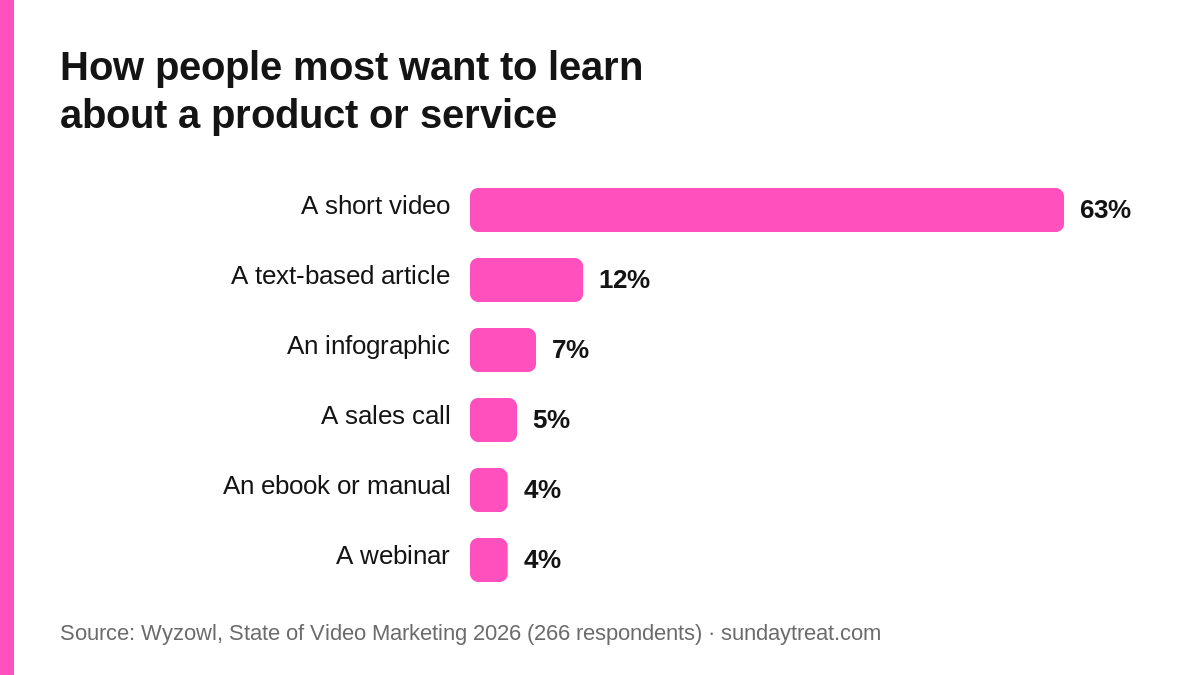
Asked how they would most like to learn about a product, 63% chose a short video, far ahead of text articles on 12% (Wyzowl, 2026).
89% of consumers say video quality affects how much they trust a brand (Wyzowl, 2026).
Great creative strategy is uniform across every platform, but the actual assets are very different, each one optimised for the platform it’s running on.
 Gulliver Moore
Co-Founder, Sunday Treat
How the UK watches video
For a UK audience, Ofcom’s annual Online Nation study is the most authoritative read on viewing habits.
UK adults spend 4 hours 30 minutes a day online outside work, up 10 minutes year on year (Ofcom, Online Nation 2025).
94% of UK adult internet users use YouTube, and it now commands 51 minutes of daily watch time, up from 47 minutes the year before (Ofcom, 2025).
UK 18 to 34 year olds spend 49 minutes a day on TikTok (Ofcom, 2025).
74% of UK 15 to 24 year olds actively follow influencers (European Parliament Research Service, 2025).
How the US watches video
The US picture skews even more heavily towards YouTube and short-form discovery.
85% of US adults use YouTube, the most widely used online platform in the country, and around 90% of US teens use it (Pew Research Center, 2025).
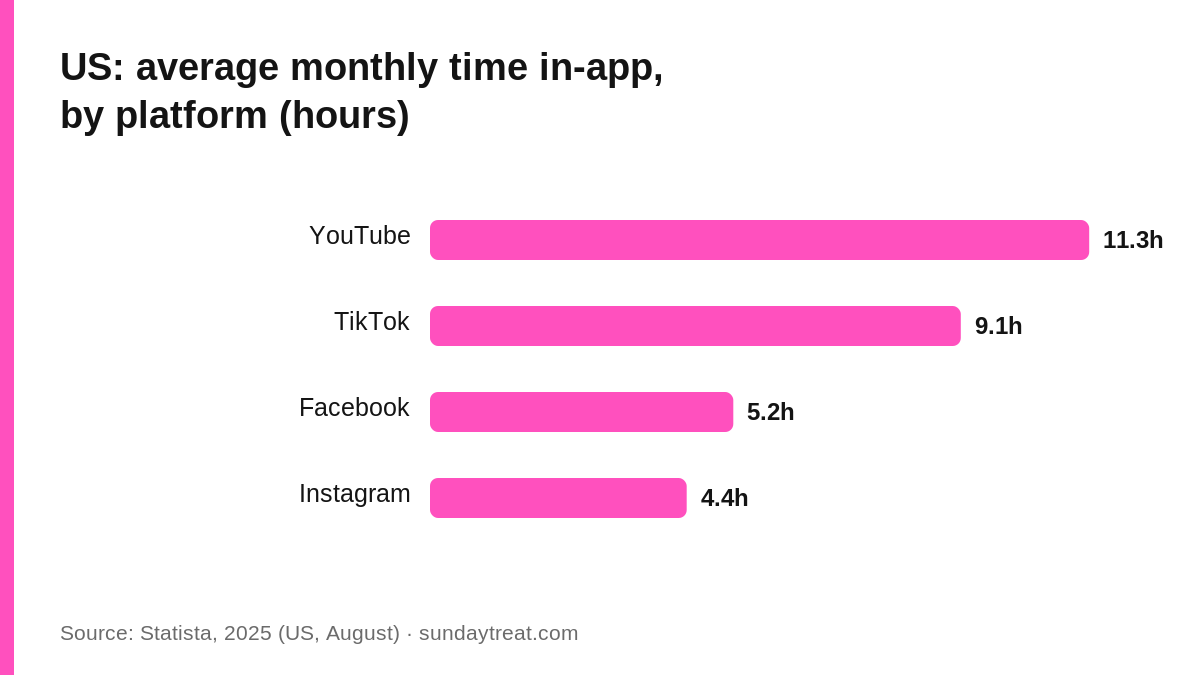
By monthly time in-app in the US, YouTube leads on 11.32 hours, then TikTok on 9.05, Facebook on 5.15 and Instagram on 4.41 (Statista, 2025).
61% of US users say they are more likely to use YouTube than other platforms to research brands (Google / YouTube Ads).
1 in 5 Americans now regularly get news on TikTok, up from just 3% in 2020, rising to 43% among under-30s (Pew Research Center, 2025).
Short-form video and TikTok
Short-form is the defining format of the era, and the data backs it up. Our one rule here: make the content for the platform it is going to land on. Pick a foundational platform (ours is TikTok), get it right there first, then adapt what works onto LinkedIn, Instagram and Shorts in a format that suits each one. One export pushed everywhere is the fastest way to be ignored everywhere. It is exactly what our influencer and social team do every day.
TikTok has passed 3.5 billion global monthly active users (Sofina / ByteDance, 2026).
60% of TikTok users name short-form video under 60 seconds as their most frequent format, while only 32% prioritise long-form (Sprout Social, 2026).
The average TikTok video grew to 42.7 seconds in 2024, up from about 39 seconds in 2023 (Statista / Metricool).
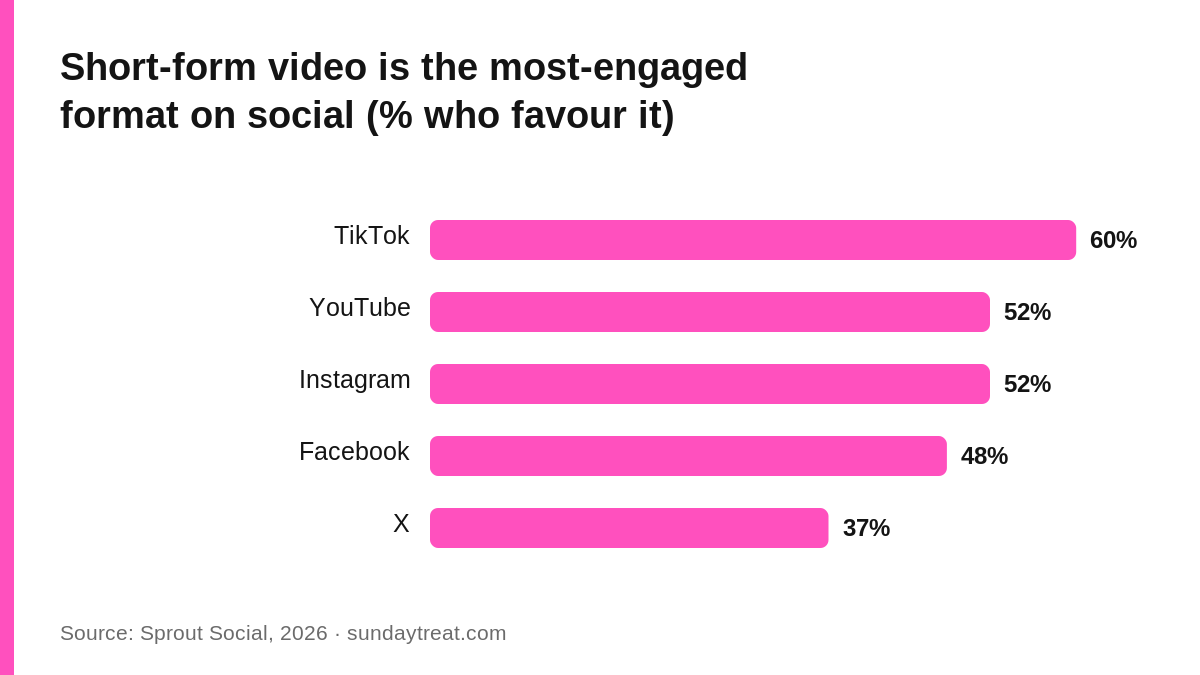
Short-form under 60 seconds is the most-interacted format across platforms: 52% on Instagram, 48% on Facebook, 52% on YouTube and 37% on X (Sprout Social, 2026).
Social video, platform by platform
Video is not one channel. Each platform rewards a different cut, length and intent.
YouTube is the most widely used video platform among marketers at 82%, then LinkedIn (70%), Instagram (69%), Facebook (66%) and TikTok (40%) (Wyzowl, 2026).
Instagram Reels have reached an annual revenue run rate of more than 50 billion dollars across Facebook and Instagram (Meta, 2025).
74% of Facebook videos are watched without sound, which is why captions and sound-off design matter (Sprout Social, 2026).
On LinkedIn, live video gets 24 times more comments and 7 times more reactions than native video, and the average video watch time is 13 to 15 seconds (LinkedIn; Statista, 2025).
Video ad spend and budgets
This is where the structural shift is clearest. Spend is leaving linear TV for digital video, and the US figures are the bellwether.
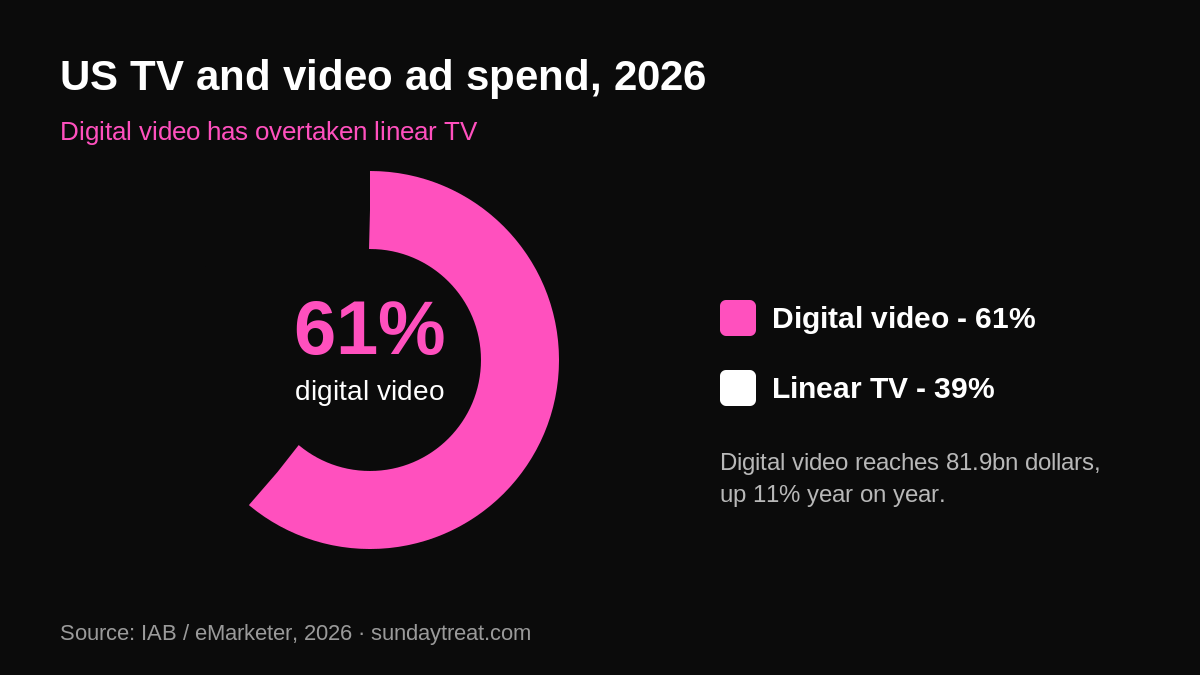
US digital video ad spend will grow 11% to 81.9 billion dollars in 2026 (IAB / eMarketer, 2026).
Digital video will account for 61% of all TV and video ad spend in 2026, against 39% for linear (eMarketer, 2026).
In 2026, US connected TV upfront ad spend overtakes primetime linear TV upfront spend for the first time (eMarketer, 2026).
On the buyer side, 41% of marketers spent on video ads this year (up from 36%), and 92% plan to spend the same or more in 2026 (Wyzowl, 2026).
AI in video production
AI moved from novelty to normal in a single year, the fastest shift in this whole dataset.
63% of video marketers used AI tools to create or edit marketing videos in 2026, up from 51% a year earlier (Wyzowl, 2026).
On cost, marketers are split: 30% think video is getting cheaper, 32% see no change, and 38% say costs are rising (Wyzowl, 2026).
Our honest take: do not be scared of AI, but do not hand it the keys either. We use it to speed up the boring parts and save our skin when a deadline bites, never to replace the human judgement that makes a film worth watching. Used well, it is invisible to the viewer. The moment an audience can tell a machine made it, they switch off. We went deeper on where AI genuinely helps and where it falls short in our guide to the future of AI in animation.
Explainer, animation and format mix
51% of marketers mostly create live-action video, then animation at 23% and screen recording at 19% (Wyzowl, 2026).
96% of people have watched an explainer video to learn about a product, which is why explainer remains the second most created format after social video (Wyzowl, 2026).
Sunday Treat data: what we see across our campaigns
Industry averages are useful, but our own numbers show what a video-first approach looks like in practice. These come from live Sunday Treat campaigns.
Plus a win at The Drum Awards.
What this means for brands in 2026
Here is our honest read on all this. The argument about whether to bother with video is finished. When 91% of businesses are already in and 84% of people are actively asking brands for more, the only question left is whether yours is good enough to get picked over everyone else’s. Sit with that 89% trust-in-quality number for a second, because what it really says is that a cheap-looking video now costs you trust, not just views.
Short-form is not a phase you can wait out either. It is where attention has gone, and TikTok, Reels and Shorts are all telling you the same thing. The bit most people get wrong is thinking short-form on its own is a strategy. The brands that win pair quick, scroll-stopping video at the top with deeper content that does the actual convincing, then put real money behind whatever works. And they cut each one for the platform it lives on, because an edit that flies on TikTok can die on YouTube.
And the money has voted. With US digital video ad spend now past linear TV, the audience and the budgets are finally in the same room. If you want a hand turning any of this into a plan, our creative strategy and performance marketing teams live in exactly this space, and our content production and video production teams make the work. We will, naturally, find the fun in it.
Want video that earns its place?
We are a London video and content agency, and a winner at The Drum Awards. Let’s make something worth watching.
Get In Touch