
User-generated content is the most trusted, best-converting content most brands are still not properly using. Real people, filming real experiences on their phones, now outperform glossy brand ads on the metrics that matter, and audiences increasingly scroll past the polished stuff to find it. Here is the data behind UGC in 2026, why it works, the brands doing it well, and how to build a UGC programme that actually drives sales rather than just filling a feed.

What user-generated content actually is
User-generated content, or UGC, is content about your brand made by people who are not your brand: customers, fans, employees and independent creators. It spans a customer’s unboxing video, a five-star review with a photo, an employee showing what a day at work really looks like, and the growing category of the paid “UGC creator” who makes authentic-feeling content for brands to use in their own channels and ads.
One useful distinction. Influencer marketing rents someone else’s audience. UGC is about the content and the trust it carries, which you then own and put to work across your website, your ads and your emails. The two overlap, but UGC is the broader, more durable asset.
The data: why UGC wins
The numbers are not subtle. People trust other people far more than they trust brands, and that trust shows up directly in conversion.
Around 84% of consumers say they trust a brand more when it uses UGC, and roughly 92% trust recommendations from other people, even strangers, over branded content (Nielsen; industry research, 2026). It converts, too: product pages that feature customer content convert around 74% higher, and UGC-style creative has been found to outperform polished brand ads by close to 29% on conversions (industry research, 2026).
That last number is the whole opportunity. Only about 16% of brands have a dedicated UGC strategy, despite the performance data, which means doing this properly is still a genuine edge rather than table stakes.
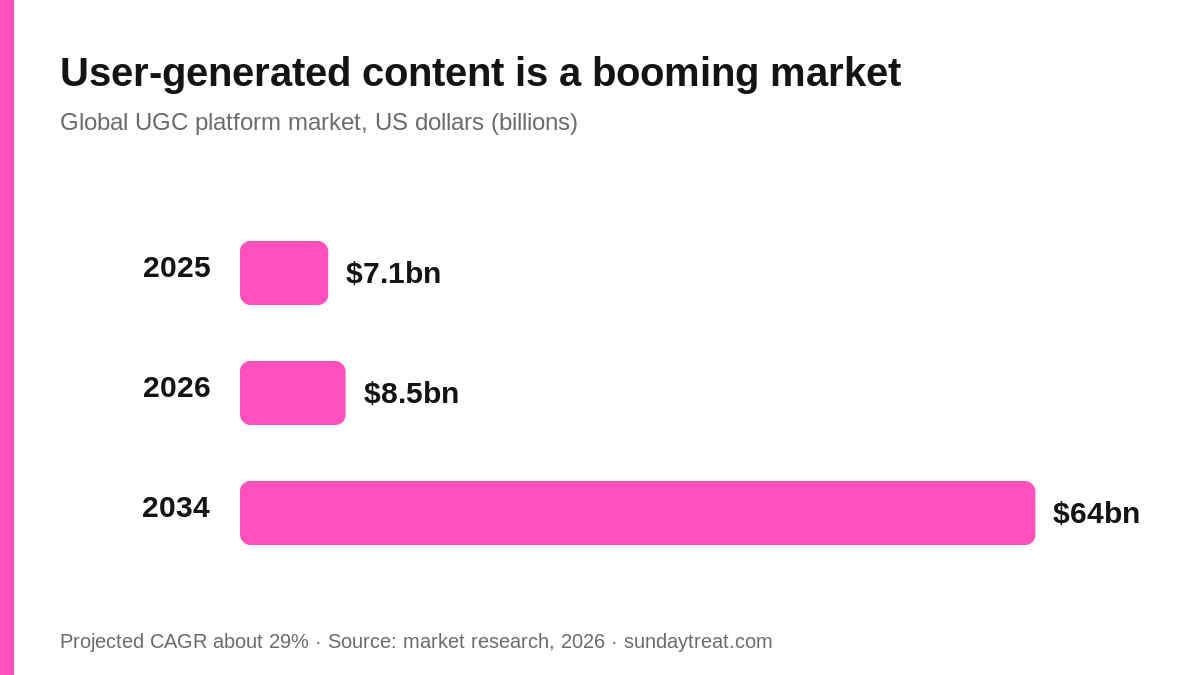
The pattern holds right across the funnel. UGC-style social posts have driven more than 10x the conversion of non-UGC posts, customer reviews can lift conversion by as much as 270% on lower-priced items, and roughly 60% of people name UGC as the most authentic form of marketing (industry research, 2026). On TikTok, where so much of this content lives, organic engagement runs higher than on any other major platform.
Why it works: the trust engine
UGC works because authenticity is the scarce asset. In a feed full of polished, increasingly AI-assisted perfection, a slightly shaky video filmed on a real kitchen counter reads as honest, and honest is what earns attention and belief. It is the same human-premium shift we wrote about in the future of content marketing: as the cost of average, glossy content falls to zero, the value of something genuinely human goes up.
Social proof is doing the heavy lifting. When a prospective customer sees a real person like them using and enjoying your product, it removes risk in a way a brand claim never can. UGC is not cheaper advertising. It is more believable advertising.
The camera is just one tiny part of the equation. A real person who genuinely loves what you do, filmed on a phone, will beat a polished ad more often than not, because people can tell when something is real.
 Gulliver Moore
Co-Founder, Sunday Treat
UGC and the AI authenticity premium
There is a reason UGC is having its moment now, and it is AI. As generative tools flood every feed with cheap, polished, machine-made content, the one thing AI cannot convincingly fake is a real person’s genuine experience. That scarcity is exactly what gives UGC its rising value. We dug into this shift in our piece on the future of content marketing, and UGC is the clearest example of it in action.
The irony is that AI and UGC work best together. Use AI to handle the volume, the variations, the rough edits and the admin, and use real people for the trust. The brands that win will not choose between them. They will let the machine scale the work and let humans carry the credibility.
The shift to micro-creators and long-term relationships
The way brands source UGC has changed. The money is moving away from big-name influencers and one-off posts towards smaller, trusted creators, often with under 10,000 followers, whose content feels more relatable and converts harder. Just as importantly, brands are building long-term, performance-driven relationships with a roster of creators rather than paying for a single burst of content.
That shift mirrors how the best agencies already work with talent: pick people who genuinely fit the brand, keep them for the long run, and let trust compound. It is exactly the model our influencer and social team runs for clients.
The formats that actually convert
Not all UGC performs equally. The formats that consistently work are short, around 15 to 30 seconds, and built on a real moment rather than a script: unboxings, honest reviews, point-of-view demonstrations, before-and-afters, and day-in-the-life clips. The common thread is usefulness or relatability, not production value.
A practical rule we like: if it looks like an ad, it will be treated like an ad. The job is to make content that earns its place in the feed on its own merits, then let the product do the selling inside it.
Where UGC works across the funnel
UGC is not just a top-of-funnel awareness play. It earns its keep at every stage. At the top, authentic clips stop the scroll and introduce the brand. In the middle, reviews, demos and comparisons answer the “is this right for me” question better than any brand claim. And at the bottom, customer content on product pages and in retargeting ads is what closes the sale, which is why product pages featuring UGC convert so much harder. The brands seeing real returns map their UGC to each stage of the journey rather than dumping it all into awareness and hoping.
How to run a UGC programme that drives sales
This is where most brands fall down. They collect a few nice clips and stop. A UGC programme that moves the numbers runs as a system, with five moving parts.
First, source deliberately: invite reviews and customer videos, run a hashtag or challenge, and build a small roster of UGC creators who fit the brand. Second, brief without over-directing, give creators the point and the guardrails, then trust them to sound like themselves, because the moment you script it, you kill the thing that makes it work. Third, get the rights, always secure written permission and usage terms before you repost or run content as an ad. Fourth, put it to work everywhere: product pages, paid social, email, organic. And fifth, measure what matters, conversion and cost per acquisition, not just likes.
The multiplier most brands miss is paid. Your best-performing organic UGC is also your best ad creative, so the moment a clip proves itself, put budget behind it and let it reach the people most likely to buy. That loop, source, test organically, then scale the winners with paid spend, is how UGC stops being a nice-to-have and becomes a measurable acquisition channel. Keep a steady stream of fresh creator content coming in as well, because UGC ads fatigue fast, and the brands that win treat it as an always-on pipeline rather than a one-off shoot.
The strategic shift: stop thinking of UGC as free content to repost, and start treating it as a managed programme, sourcing, rights, briefing, distribution and measurement, run on purpose. That is the difference between a few nice clips and a genuine growth channel.
The mistakes brands make with UGC
A few errors come up again and again. Over-scripting the creator until the content sounds like an ad and loses the authenticity that made it work in the first place. Treating UGC as free, so it is collected by luck rather than sourced on purpose, and never scaled. Skipping the rights, then being unable to use the best content in paid, where it would earn the most. Chasing follower counts instead of fit, when a relatable micro-creator usually converts better than a big name. And measuring the wrong thing, celebrating likes while ignoring whether any of it actually drove a sale. Avoid those five and you are already ahead of most brands.
Rights, permission and disclosure
The unglamorous part that protects you. Always get written permission and clear usage rights before you reuse someone’s content, especially before running it as a paid ad, a customer posting about you does not grant you a licence to advertise with it. And where content is paid or incentivised, it must be disclosed clearly, in line with advertising standards in the UK and US. Getting this right is not just compliance, it is part of the trust that makes UGC work in the first place.
Does UGC work for premium and B2B brands?
A fair question, because UGC can feel like a consumer-goods tactic. The answer is yes, but it looks different. For premium brands, UGC is less about volume and more about credibility: real customers, founders and employees sharing genuine moments that money cannot manufacture, used selectively alongside high-end brand work rather than instead of it. For B2B, the equivalent is employee-generated content and honest customer stories, which consistently out-engage polished corporate posts. The principle does not change with the price tag or the buyer. People trust people. The job is simply to find the authentic voices that fit your brand and give them a reason to share.
Brands that get UGC right
The proof is in the brands that built real businesses on it. Two stand out.
GoPro turned its customers into its marketing department. Through its annual Million Dollar Challenge and GoPro Awards, it sources epic footage straight from users, and today a large share of its video and social content is user-generated. The result is an endless, authentic content engine no in-house team could match.
Apple’s “Shot on iPhone” did the same for a very different product. By putting photos and films captured by ordinary iPhone users at the centre of its advertising, Apple turned product capability into authentic social proof, generating tens of millions of interactions and more user submissions than any paid shoot could produce.
British brand Gymshark built a fitness empire on the same principle, with community challenges and long-term creator partnerships generating billions of views. Different products, same lesson: hand the camera to real people and give them a reason to point it at you.
What this means for brands in 2026
Here is our honest read. UGC is not a hack or a cheap shortcut, it is the most trusted form of content there is, and the brands treating it as a proper programme are quietly building a moat. The ones still posting the occasional customer repost are leaving the best-converting content they could have on the table.
So commission the glossy brand work that sets your standard, and build the UGC engine that earns trust at scale, the two together are far stronger than either alone. It rhymes with everything we keep seeing, from the video marketing statistics for 2026 to how brands actually go viral: real, human content wins. If you want a hand building a UGC and creator programme that drives results, our content production and performance marketing teams do exactly this. The tools change. The trust does not. And we will, as ever, find the fun in it.
Want UGC that actually sells?
We are a London video and content agency, and a winner at The Drum Awards. Let’s build a creator and UGC programme worth investing in.
Get In Touch