Every production company website now claims an “AI-powered pipeline”, and most of those claims dissolve the moment you ask what tool did what on which job. So here is the honest version. This is what AI video production actually looks like inside a working London studio: the tools that survived contact with real shoots and real clients, the ones we binned, and a straight answer on where AI in video production saved time and where it quietly cost us some. No demo-reel futurism, just the state of the kit in 2026.
Where AI actually fits in a production pipeline
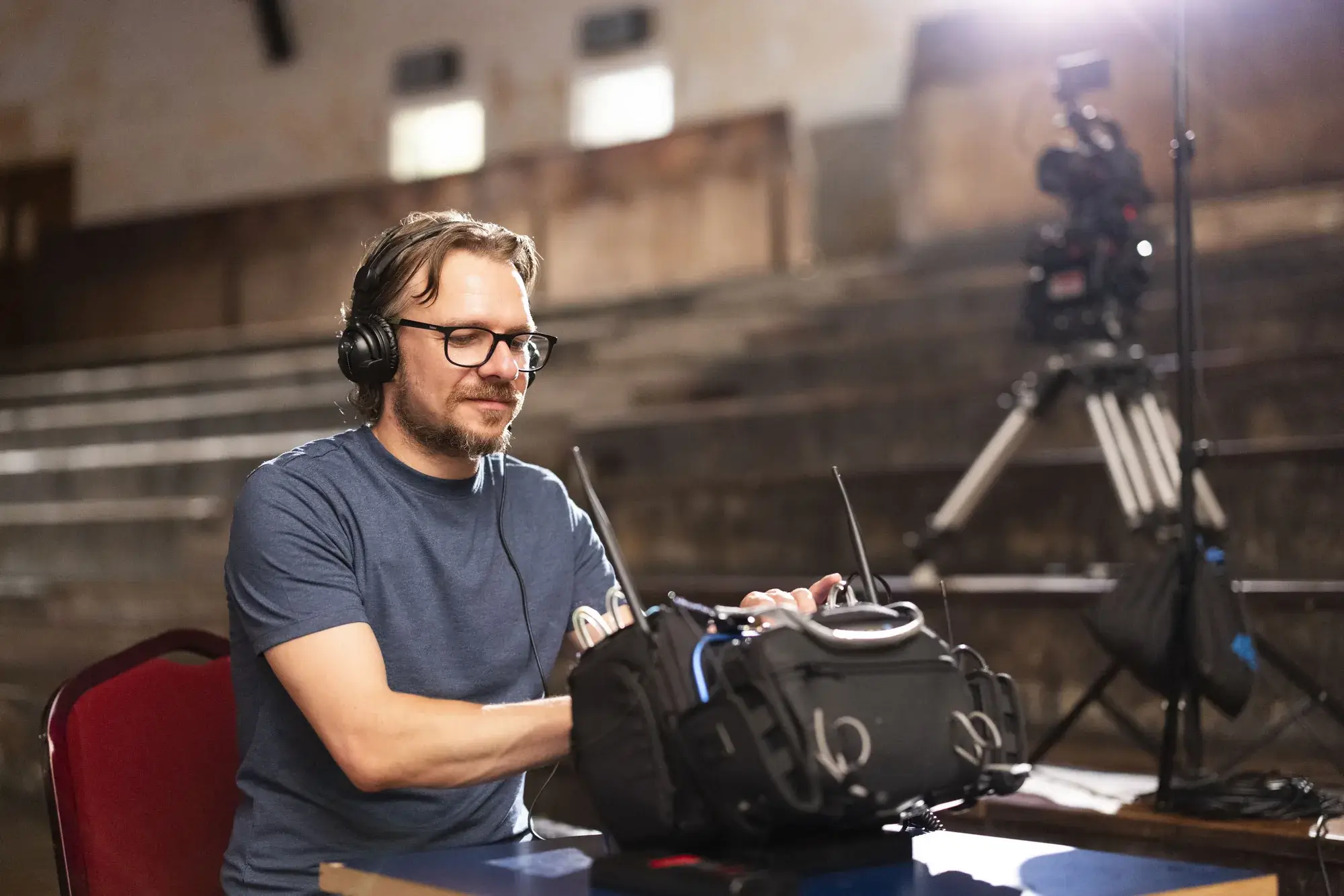
Almost all of the real value sits at the two ends of the pipeline: pre-production and post. In between, on the actual shoot day, AI still does close to nothing, and we think that is exactly as it should be. The industry numbers agree the tools have gone mainstream: 63% of video marketers have now used AI tools to help create or edit video, up from 51% a year earlier (Wyzowl, 2026), and Adobe’s research puts creative generative AI use among professional creators at 86% (Adobe, 2025). Adoption is no longer the interesting question. What people actually keep using is.
Pre-production: the quiet wins
Pre-production is admin-heavy, and admin is where AI behaves best. Four uses have stuck for us.
First drafts of research and treatments. A model can summarise a sector, a competitor’s output and a client’s past campaigns in minutes, which used to be an afternoon. The thinking and the angle still have to be ours, because the first thing you learn is that generated ideas all sound like everyone’s ideas. Second, moodboards and style frames: generated images are a fast way to show a client three visual directions before we commit to a photographer or a location, and we label them as AI previews, never as finished work. Third, pre-viz. Rough AI-generated frames and animatics let us test a shot sequence before we pay a crew to stand in a car park finding out the hard way. And fourth, meeting transcription, turning an hour-long client call into a usable brief the same day.
AI is getting incredibly good now, and I’d be lying if I said my team wasn’t scared of it. But for us it’s been thinking about how we can implement AI in small ways in the production process, to both speed up people’s workflows but also get them confident about expanding even further into using AI tools.
 Gulliver Moore
Co-Founder, Sunday Treat
That “small ways” discipline matters. Our standard turnaround runs about three weeks of pre-production and two weeks of post, and a fast job compresses to roughly 10 working days spread over two weeks, brief to broadcast. On those timelines you do not gamble the schedule on an experiment. You let AI absorb the paperwork so the humans can spend the saved hours on the creative, which is the part the client is actually paying for.
On the shoot: almost nothing, on purpose
Here is the bit the AI-pipeline marketing never mentions: on set, the kit is still cameras, lights, and people who know what to do with them. A shoot day is the most expensive and least repeatable part of any production, and nothing generative currently earns a place in it. The AI contribution to a shoot is upstream. Tighter pre-viz means fewer wasted setups. A better-organised shot list means the day wraps on time. And knowing that post can now stretch a clip by a couple of seconds if a pan ends early gives our video production team a small safety margin it never used to have. The craft on the day, though, stays entirely human, and clients can tell.
Post-production: where the hours actually come back
Post is where AI stopped being a novelty and became furniture. AI video editing in 2026 is not a separate app that cuts your film; it is a layer of assists inside the NLE you already use. Most lists of AI tools for video read like app-store dumps, so ours is short, because the bar for staying in our pipeline is a real deadline. The everyday list looks like this.
Transcription first, because it changed our edit workflow more than any other single tool. Every interview and every take gets transcribed automatically, so a producer can build a paper edit from the rushes on the same day as the shoot, searching for the sentence instead of scrubbing for it. On a recent founder-interview job that meant a highlighted transcript by 6pm, a selects sequence the next morning, and a first assembly a full day earlier than our old logging workflow would have allowed. Nobody on the team would give that up now. Footage search is close behind: Premiere’s Media Intelligence, rolled out in version 25.2 in April 2025, lets an editor search hours of material with a natural-language query and, usefully for client work, runs its analysis locally (Adobe, 2025). Captions and translation are now near-automatic, with Premiere translating captions across 27 languages. Audio cleanup, denoising and the polite removal of a distant police siren are one-click jobs that used to be billable hours.
Then there is versioning, the least glamorous and most valuable one. Modern campaigns are not one film, they are a family of them: when we produced around 50 deliverables from a single campaign for Revolut and Grace Beverley, reformatting, resizing and re-captioning across 16:9, 9:16 and 1:1 was exactly the kind of repetitive work AI-assisted tooling now accelerates for our content production team. And for genuine emergencies, generative patch tools like Generative Extend can add up to 2 seconds of video to a clip that was trimmed a breath too tight (Adobe, 2025). It has saved a delivery deadline more than once. That is its job: a fire extinguisher, not a co-director.
What we tried and binned
The failures are more instructive than the wins, so here they are.
Generative AI video as finished client footage. The demos are astonishing and the reality is a rights and consistency minefield: characters drift between shots, brands rightly worry about training-data provenance, and audiences have become sharp at spotting the synthetic sheen. Fully AI voiceover for broadcast work went the same way; it reads competently and lands emotionally flat, and voice rights are still a legal grey zone we will not put a client inside. AI scriptwriting beyond a first-draft skeleton got binned because everything it wrote sounded like the average of the internet, and the average of the internet is not a creative position. Auto-editing tools that promise a finished cut from raw rushes fell at the same fence: they can find the moments, but they cannot feel which moment matters. And AI-generated music failed the simplest test of all, our composers and licensed libraries are better, and the PRS position is clean.
None of these are permanent verdicts. We re-test roughly every quarter, because the tools genuinely do improve. But “binned for now” is an honest category more agencies should admit to having.
The honest maths: saved time vs new time
Did AI make us faster? Yes, unevenly. Transcription-led paper edits save real hours on every single job. Versioning at campaign scale, the Asda “Pop the Bublé” job needed 16 assets in 10 days, is where the assists genuinely change what a small team can promise. Admin drafting quietly returns an hour here and there all week. Our own TikTok output, planned two weeks ahead, leans on transcription and caption tooling constantly.
But new costs appeared too, and nobody puts these on the pipeline diagram. Generated assets need a harder QC pass than human work, because their errors are weirder (a moodboard frame with impossible architecture will derail a client call). Prompt roulette on a hero image can eat the afternoon it was meant to save. And transparency takes time: we tell clients where AI touched the work, which occasionally means a longer conversation about provenance than the task itself took. Worth it. Trust is the actual product.
The wider data mirrors our experience: despite two years of AI hype, 38% of video marketers say costs are rising, with only 30% seeing video get cheaper (Wyzowl, 2026). AI has not made video cheap. It has moved the spend from grunt work to craft, which is a trade we would take every time.
The AI video production reality check
The big-industry signal is worth reading closely, because it matches the small-studio experience. When Netflix used generative AI for finished footage for the first time, a building collapse in The Eternaut, co-CEO Ted Sarandos was specific: the shot was completed roughly 10x faster than a traditional VFX workflow and would not have been affordable for that show’s budget otherwise (Netflix Q2 2025 earnings call, July 2025). One shot, in one episode, chosen because it was a background spectacle rather than a performance. That is the shape of real adoption: targeted, budget-driven, and invisible in the credits. On the animation side the story is moving even faster, and we have written separately about the future of AI in animation, where the tools, the ethics and the craft arguments deserve their own space. For the broader numbers, our video marketing statistics roundup tracks the full data set.
How to try this without breaking your pipeline
If you run a production team and want the wins without the chaos, the sequence that worked for us is boring and repeatable. Start with transcription, because it is cheap, low-risk and instantly useful, and let the team feel a tool saving them an evening before you ask them to trust anything bigger. Adopt one tool at a time and give it a real job on a real project, not a sandbox demo, because sandbox demos always succeed. Measure hours, not vibes: if a tool has not clearly returned time within a month, it goes on the binned list, and keep that list written down so you stop re-testing the same disappointment every quarter.
Two governance rules earn their keep. Put an AI-disclosure line in your statements of work so clients hear it from you first, in plain language, before they hear it from a rumour. And route every generated asset through the same QC pass as camera-original material, with one extra question attached: would we be comfortable explaining exactly how this was made? If the answer wobbles, so should the asset.
Will AI replace video editors?
No. It is already replacing parts of the job, and the parts it is replacing are the parts editors never loved: logging, syncing, searching, conforming, captioning. What is left over is the actual work, taste, story sense, and the judgement to know which of the 40 takes contains the human moment worth building a film around. A machine can find every smile in the rushes. It cannot tell you which smile is true.
Our position, and Gully’s view since the team first got nervous about this, is that the fear is better answered with fluency than avoidance. The editors who learn these tools get their evenings back and spend more of the day on cutting. The production companies that pretend nothing has changed will be undercut on the boring work and out-crafted on the good work, a bad place to stand. And the ones claiming AI does everything? Ask them what tool did what on which job, and watch the pipeline diagram wobble.
Talking honestly about AI in your next production?
We are a London video and content agency, a winner at The Drum Awards, and we will tell you exactly where AI does and does not belong in your project.
Get In Touch