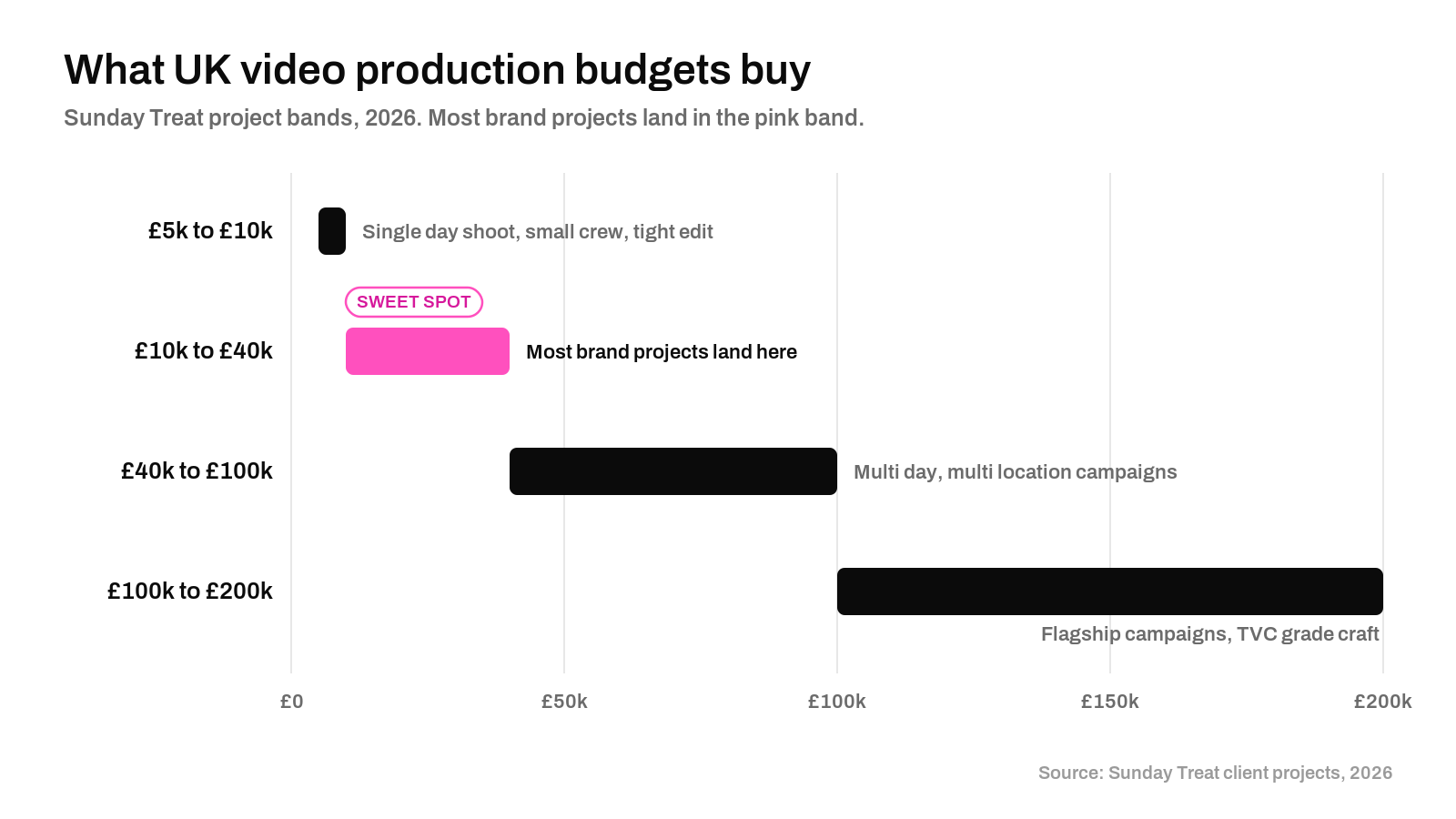
Ask ten agencies what a video costs and you will get ten shrugs and a “depends”. Not helpful. So here are our actual numbers: Sunday Treat projects run from £5,000 up to £200,000, and most of our work lands between £10,000 and £40,000. This is the real guide to video production cost in the UK in 2026: what each budget band buys, the five things that genuinely drive the price, published crew day rates, and how to make whatever budget you have work harder.
A quick word on why you can trust these figures. We are a London video and content agency, a winner at The Drum Awards, and we price real productions every week for everyone from small charities to Google, Revolut and Asda. Nothing below is theoretical.
How much does video production cost in the UK?
Professional video production in the UK costs anywhere from £5,000 to £200,000 or more. That is the honest range we quote across at Sunday Treat, and our sweet spot, where most projects land, is £10,000 to £40,000. In that band you get a properly crewed shoot, strong creative, full post-production and a set of platform-ready deliverables.
The range is that wide because “a video” is not one thing. A one-day interview shoot with a two-person crew is a completely different animal to a three-day, multi-location campaign with actors, an art department and a 30-line deliverables list. The craft standard does not change across our price bands. The scale does.
For context, plenty of businesses make video for far less: almost 40% of companies spent under 5,000 dollars on video production last year (Wistia, 2026). Most of that is self-shot or template-edited content, and it has its place. The bands in this guide are for commissioned, professional work, the kind you would happily put paid media behind.
Worth knowing if you are budgeting across the Atlantic: UK pricing tends to be the better deal. Around 40% of our work is in the US, and when we pitch against New York agencies we usually come in cheaper with a bigger creative ambition, partly because the New York scene is expensive and heavily unionised, and partly because we run pre-production and post back in London where the costs are lower. Same crews on the ground, leaner engine behind them. If your brand buys video in both markets, price them separately rather than assuming one rate card travels.
The five things that actually drive the price
Five variables set the cost of almost any production: crew, kit, shoot days, post-production and usage. Every quote you will ever receive is some combination of those five, so it is worth knowing how each one behaves.
Crew. People are the biggest line on most budgets. The average UK freelance videographer day rate is around £550, and freelance video producers average about the same (The Freelancer Club, 2025). Specialist grades price above that, and union rate cards make a point every buyer should understand: published rates are for labour only, kit is charged separately, and anything beyond a contracted 10 or 11 hour shooting day is overtime (BECTU Camera Branch, 2025).
Gully’s position on crew size is blunt: it should follow the brief, not precede it. Some of the best work we have made in the last five years came from crews of three to five people with a camera and a really clear direction. A 30-person unit is occasionally exactly what a job needs. It is never the default.
Kit. Cameras, lenses, lighting, sound and monitoring are usually hired per day, and the package scales with the creative. A gimbal and a two-light setup is a few hundred pounds a day. A cinema camera package with a full lighting truck is thousands.
Shoot days. Each extra day multiplies the crew and kit lines, which is why day count moves a budget faster than almost anything else. And here is the counterintuitive bit: a second or third day does not automatically make the film better. A bloated schedule can dilute focus and generate more footage than anyone has time to edit properly. We would rather shoot one sharp day than three flabby ones.
Post-production. Editing, motion graphics, colour grading, sound design and versioning are priced in days too. A tight edit of a single film might be three to five days. A campaign with dozens of cutdowns can be weeks of edit time, which is exactly why the deliverables list matters so much (more on that below).
Usage. Where the film runs, and for how long, changes the price. Actors, presenters, music and stock all carry licensing that scales with the media behind them. A film for your own organic channels is licensed very differently to a TV commercial, so tell your agency where the work will run before they quote, not after.
Sample budget tiers: what your money actually buys
Here is how the bands break down in practice. Treat these as honest reference points rather than a menu, because every project is scoped from scratch.
| Budget band | What it typically buys | Best for |
|---|---|---|
| £5,000 to £10,000 | A single shoot day with a small crew (one or two people), simple location, interview or documentary style coverage, a focused edit and a handful of social cutdowns. | Founder stories, testimonials, event coverage, simple social content |
| £10,000 to £40,000 | One or two shoot days, a fuller crew (director, producer, camera, sound, sometimes art department), proper creative development, licensed music, graded and sound-designed post, and a full set of platform-specific deliverables. | Brand campaigns, corporate films, product launches, always-on content blocks |
| £40,000 to £100,000 | Multi-day, multi-location shoots with actors or presenters, art direction, larger crews, motion design and heavyweight post across dozens of assets. | Multi-format campaigns, national social and digital pushes |
| £100,000 to £200,000+ | Flagship campaign productions: TVC-grade crews, casting, studio builds or complex locations, extensive usage licensing and a deliverables matrix covering every channel. | TV and cinema advertising, flagship brand moments |
Format shifts the maths inside each band. A cinematic brand film concentrates spend on craft and sits toward the upper tiers, while animated explainer videos often land in the lower two bands because there is no physical shoot at all. Corporate video production costs sit across these same bands, with most interview-led corporate work in the first two.
Want to know what your budget could actually do?
Tell us the number and we will tell you, honestly, what it buys. We are a Drum Award winning team that makes budgets work hard at every scale.
Get In TouchDay rates: the building blocks of every quote
Video production pricing is built almost entirely from day rates, so they are worth a closer look. The published averages are a useful sanity check: around £550 a day for a freelance videographer and a similar figure for producers and editors (The Freelancer Club, 2025). BECTU’s Camera Branch also publishes a rate card built from real survey data submitted by working crew, which is the closest thing the industry has to a public price list.
Three things stop a day rate being the whole story. First, rates are labour only: the camera package, lighting and van are separate lines. Second, a “day” has edges. Standard structures assume a 10 or 11 hour shooting day including lunch, and hours beyond that are overtime (BECTU Camera Branch, 2025). Third, the visible shoot day sits on top of invisible ones: prep, travel, kit checks, data wrangling and backups all take real time from real people.
Location moves the needle too. Video production costs in London sit at the top of the national range, both because senior crew cluster there and because everything around the shoot (locations, parking, logistics) costs more. It is one reason we keep our own kit in a van and our post-production in-house: efficiencies we control are savings our clients keep.
Why two quotes for the same brief can be thousands apart
Because the two agencies made different assumptions. When quotes diverge wildly it is rarely because one is ripping you off. One has assumed two shoot days, ten deliverables, a senior director and paid usage. The other has assumed one day, three deliverables, and organic-only distribution. Same brief, different film.
Seniority, overheads and margin play a part as well, and yes, occasionally padding does too. The fix is not to haggle. The fix is transparency, and it is something we feel strongly about.
We’re pretty transparent about our costing, you know, we’re always really happy to provide itemised breakdowns and we charge clients the same for everything.
 Gulliver Moore
Co-Founder, Sunday Treat
How to compare quotes properly: ask every agency for an itemised breakdown, then compare line by line. Check the number of shoot days, the crew list, the deliverables count, the revision rounds and the usage terms. If an agency will not show you the cost sheet, that tells you something in itself.
How to budget for video in 2026
The climate is on your side. UK marketing budgets were revised up to their highest level in nearly two years in Q1 2026, with a net balance of +7.3% of companies increasing spend, and video budgets swung back into growth at +5.7% after a flat patch (IPA Bellwether, 2026). UK ad spend is forecast to grow 2.5% this year. But demand is growing faster than budgets: companies are making more videos while 46% hold spend flat (Wistia, 2026). So the game is efficiency, not just scale.
Four things we tell every client. Set the budget before the creative, because the budget shapes what is achievable and we would rather design to it than discover it later. Share the number with your agency (a range is fine). Think in assets, not “a video”: our Revolut campaign with Grace Beverley produced 50 deliverables from one production, and that thinking is what makes a budget feel double its size. And plan usage up front, because retrofitting licences is always dearer than buying them at the start.
If you need volume all year round rather than one big moment, a rolling content production arrangement stretches the same money further than a string of one-off projects, because the strategy, crew familiarity and set-up costs stop resetting to zero every time.
Is professional video worth the money? Our honest take
By the numbers, yes. 91% of businesses now use video as a marketing tool, 82% of marketers say video gives them a good return on investment, and 85% of people say watching a video has convinced them to buy (Wyzowl, 2026). The medium works. The question is only whether the specific film you are commissioning is set up to work.
Which brings us to the most honest thing in this guide: sometimes the right answer is not to spend. If the creative ambition and the budget are worlds apart, the project is not being set up for success, and we have turned work down on exactly that basis. Candour up front beats disappointment later, every time.
But when the ambition and the budget line up, video is the best money in marketing. Get the scope right, insist on an itemised quote, put the spend where the audience will feel it, and work with a video production team that treats your budget like its own. That is the whole trick. And whatever the number is, we will find the fun in it.
