A great brand video does the one job most marketing can’t: it makes someone feel something about your company before they need anything from you. Not a product demo. Not a 15-second performance cut chasing a click. A proper film — the sort that earns its watch time, gets shared in a Slack channel on a Tuesday morning, and quietly rewires what people think your brand is for. We’ve spent the last decade making brand films for the NHS, Red Bull, Berkeley Homes, Sainsbury’s, HelloFresh, KLM and Action for Children, and the pattern is clear: brands that invest in story-led video pull ahead of brands that don’t. This article unpacks what a brand film actually is, why it works, what it costs in the UK in 2026, and how to brief one without wasting six months and a six-figure budget on something nobody watches past second three.
What is a brand film?
A brand film is a short piece of cinematic video — usually 60 seconds to four minutes — designed to communicate who a company is, what it stands for, and why anyone should care. It’s not a TV ad, although it might run as one. It’s not an explainer, although it might explain something. It’s not a product video, although a product can absolutely be in it. The defining feature is intent: a brand film exists to build brand equity, not to drive a same-day conversion.
The easiest way to draw the line is by what each format is measured on. A TV ad is measured on reach and short-term sales lift. A product video is measured on conversion rate and time-on-page. A brand film is measured on what people remember about you six months later — recall, association, preference, the soft stuff that compounds. Done well, it changes how your target audience talks about you in rooms you’re not in.
Brand storytelling on film tends to share three traits. It centres on a human truth rather than a feature list. It sounds like the brand and nobody else. And it’s edited with distribution in mind — there’s a hero cut, a 60, a 30, vertical lifts for social, stills for press. One shoot, ten assets, a year of fuel for your marketing strategy.
Why brands invest in brand films
The honest answer is because the maths works. Les Binet and Peter Field’s IPA research has been showing the same thing for over a decade: long-term brand-building spend produces bigger business effects than short-term activation, and the optimal split for most categories sits around 60% brand, 40% performance. Video is the format that does most of the heavy lifting on the brand side. It carries emotion, music, faces and pace in a way a banner ad simply can’t.
What changed in the last few years is distribution. A brand film used to need a TV media buy to earn its keep. Now the same film can live on YouTube pre-roll, Connected TV, your homepage hero, your sales deck, your investor update, your recruitment page and three different social cuts. The cost-per-view has collapsed. The cost-per-impression on a well-targeted YouTube campaign is a fraction of broadcast, and the targeting is better. That’s the real reason brand video budgets have grown — not because anyone fell back in love with cinema, but because the unit economics finally make sense.
There’s a second reason that gets discussed less. Sales teams use brand films. Recruiters use them. Investors watch them. A film that genuinely captures what your company is for becomes an internal artefact as much as an external one. We’ve had clients tell us a single 90-second piece closed a tender, won a hire, or unlocked a board sign-off. That’s brand awareness doing work nobody put in a media plan.
The anatomy of a great brand film
After a hundred-odd of these, a few non-negotiables show up in every film that works.
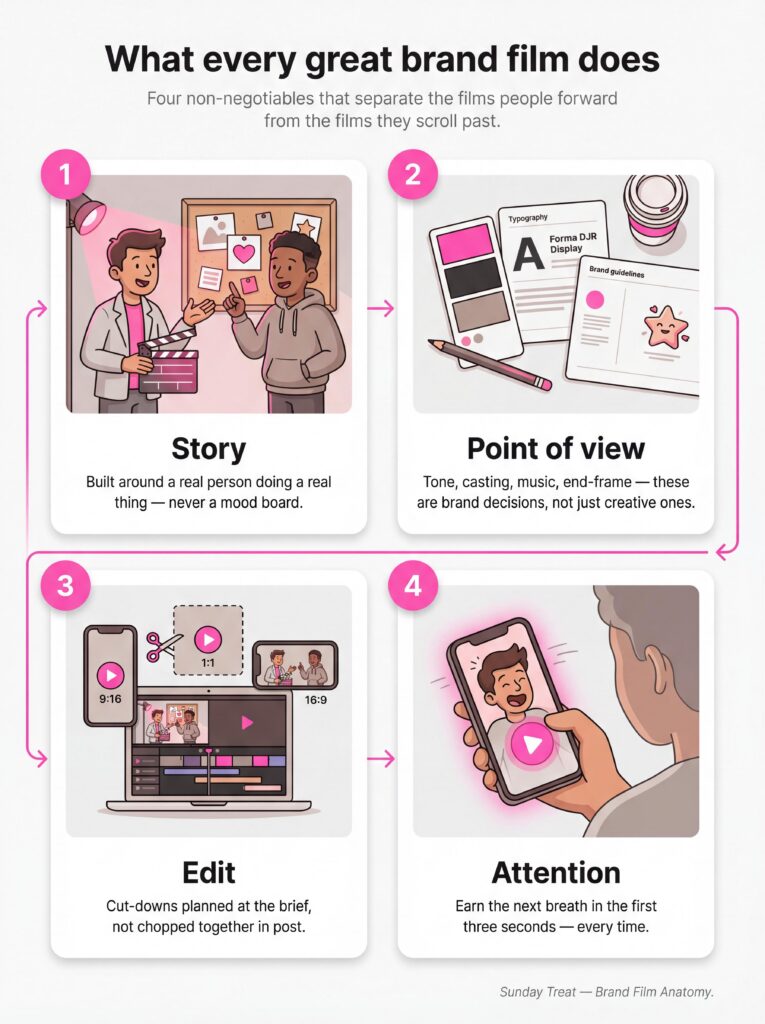
- A real story, not a mood board — built around something specific.
- A point of view that matches the brand identity.
- An edit built for the platform it’ll live on.
- A reason to watch past three seconds — earned in the craft, not the brief.
The detail on each:
A real story, not a mood board. The films that travel are built around something specific — a person, a moment, a tension, a turn. Generic uplift montages with a voiceover about “believing in better” don’t land because they could belong to anyone. The brief moment a real nurse pauses before answering a question lands because it could only belong to one place.
A point of view that matches the brand identity. Tone, pace, casting, music, grade, typography in the end-frame — these are all brand decisions, not just creative ones. A brand film for a challenger fintech should not look like a brand film for a 200-year-old insurer. If yours could be re-end-framed for a competitor without anyone noticing, it’s failed.
An edit built for the platform it’ll live on. The hero film matters, but the cutdowns matter more. Most of the views happen on phones, in feed, with the sound off for the first three seconds. A film designed only for a 16:9 launch event and then chopped up afterwards always looks chopped up. Plan the assets at the brief stage, not in the edit suite.
A reason to watch past three seconds. Whether that’s a face you weren’t expecting, a line you weren’t expecting, or a shot you weren’t expecting, something has to earn the next breath. This is craft, and it’s what separates the films people forward from the films people scroll past. Our creative strategy work starts here — figuring out the hook before we figure out the lighting.

Sunday Treat brand films we’re proud of
We could talk about principles all day. Easier to show you the work.
Action for Children — Star in Every Child. A brand film for the charity sector is a hard brief: it has to move people without manipulating them, and ask for support without sounding desperate. We built this around the children themselves, not the cause as an abstraction. The result is a film the charity can use across fundraising, partnerships and recruitment for years, not a campaign that burns out in a quarter.
NHS Organ Donation. Behaviour-change films are the hardest format in the industry — you’re asking someone to do something they actively don’t want to think about. We approached this as a brand film first, message second: who the NHS is, what consent really means in a family, and why the conversation matters before the moment matters. The film does its job by making the topic approachable rather than urgent.
Red Bull Wings for Life. Sponsorship and cause work tends to fall into one of two traps: too much logo, or too little reason for the logo to be there. The Wings for Life brand film threads that needle by treating the cause as the hero and Red Bull as the enabler. It’s the kind of film that makes you think more of the brand precisely because the brand isn’t shouting.
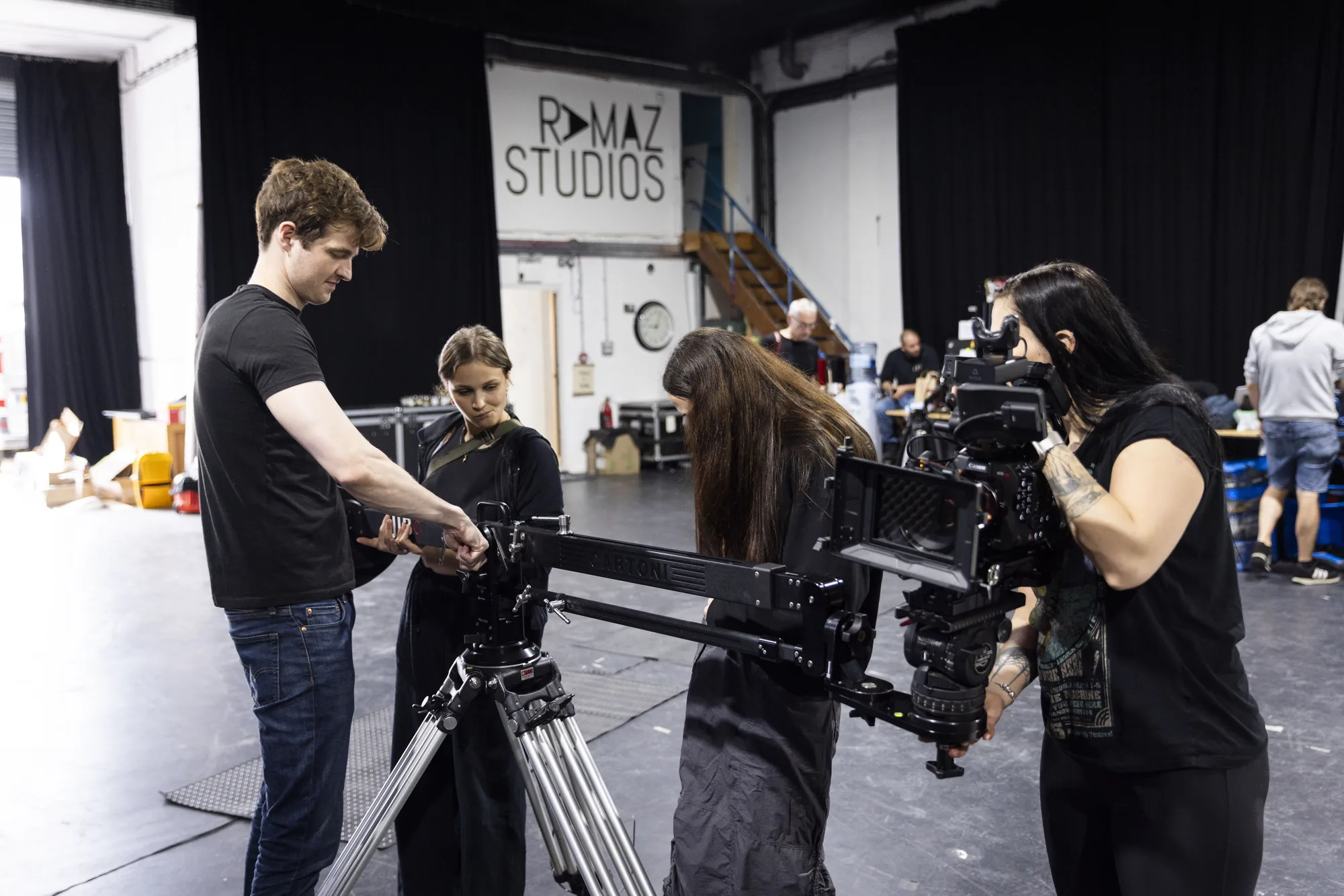
Behind the scenes on a Sunday Treat brand film. See the full case study →
Berkeley MyHome+. B2B and considered-purchase categories often default to corporate film conventions — drone shots, glass buildings, a CEO talking head. We pushed the Berkeley MyHome+ film towards the actual experience of buying a home with them: the people, the moments, the choices. It’s a brand film that happens to also be a sales tool, which is the nicest version of the format.
You can see the rest of our work over on our portfolio, including pieces with HelloFresh, Sainsbury’s, Revolut and KLM that span entertainment formats, creator-led content and travel.
When NOT to make a brand film
An honest answer no one in our industry gives often enough: sometimes you shouldn’t make one. A few cases where the money is better spent elsewhere.
- Your brand identity is still unclear — fix that first.
- You can’t distribute the film once it’s made.
- You actually need a performance asset, not a brand piece.
- You’re only doing it because a competitor did.
The longer version of each:
You don’t yet have a clear brand. A brand film amplifies whatever brand identity you already have. If yours is genuinely undefined — different on the website, the deck and the sales call — fix that first. A film built on a confused brand will come out confused, and you’ll blame the film.
You can’t distribute it. A great film with no media plan and no organic reach is an expensive screensaver. If there’s no budget set aside for paid distribution, no PR moment to attach it to, and no sales team trained to use it, the film won’t work however good it is. Distribution should be at least 1.5x the production budget for most launches.
You actually need a performance asset. If the business question is “how do we get more sign-ups this quarter”, a brand film is the wrong tool. Make a sharp performance creative, test five variants, kill the losers. Brand investment is a different timescale and a different conversation. Both matter — they just don’t replace each other.
You’re making it because a competitor did. Bad reason. The competitor’s film was made for the competitor’s brand, audience and moment. Yours needs its own justification, or it’ll feel like a cover version.
How much a brand film costs in the UK in 2026
The honest ranges, with the caveat that any number depends on cast, locations, days, post and rights. These reflect what a serious brand film production company in London is actually quoting in 2026.
- Entry tier: GBP 25,000 to 60,000. One-day shoot, small crew, one or two locations, no named talent, music library, basic grade and sound. Right for a single-purpose film — a recruitment piece, a values film, a founder story. You can absolutely make a great film at this level if the idea is sharp and the scope is honest.
- Mid tier: GBP 60,000 to 150,000. Two-to-three day shoot, proper crew, multiple locations or a built set, original music or a licensed track, full post including VFX where needed, a hero cut plus social edits. This is where most brand films we make for established UK brands sit.
- Premium brand film production: GBP 150,000 to 500,000+. Multiple shoot days, named talent or director, original score, international travel, complex post, full asset suite for a year-long campaign. This is the tier where a film can carry a brand for two or three years if it’s right.
What pushes the number around most isn’t the camera — it’s days, talent and rights. A two-day shoot is more than twice a one-day shoot once you factor in turnaround. Named talent, even modest names, can add five figures fast. And buying the music, the cast and the footage in perpetuity rather than for 12 months will move the total noticeably. Get those three lines right at the brief stage and the budget conversation gets a lot calmer.
How to brief a brand film
A short, useful checklist we wish more briefs included.
- One sentence on what the film has to change. Not what it has to say — what has to be different in the audience’s head after they’ve watched. If you can’t write that sentence, the film isn’t ready to make.
- Who it’s for, specifically. Not “UK adults 25-54”. A real person, a real moment they’d see this in, a real reason they’d give it 30 seconds.
- Where it’s going to live. Channels, formats, durations, with-sound or without, paid or organic. This shapes the film more than any creative reference.
- What you can’t change. Brand rules, legal lines, things the CEO has already said publicly, the bit of the product the film must include. Better in the brief than in round-three feedback.
- Three references — and why. Not a Pinterest board. Three films you genuinely admire, and one sentence on what each one does that yours should also do. The “why” is the useful bit.
A good brand film agency will push back on a brief that’s missing any of these. Take the pushback as a good sign.
Ready to make one?
If you’re considering a brand film and want a frank conversation about whether it’s the right move, what it would cost, and what it could realistically do for your business, we’d be glad to have it. Start with our video production page, or just drop us a note on contact us and we’ll come back the same day. We’ll tell you when a film is the right answer, and we’ll tell you when it isn’t — both are useful.
