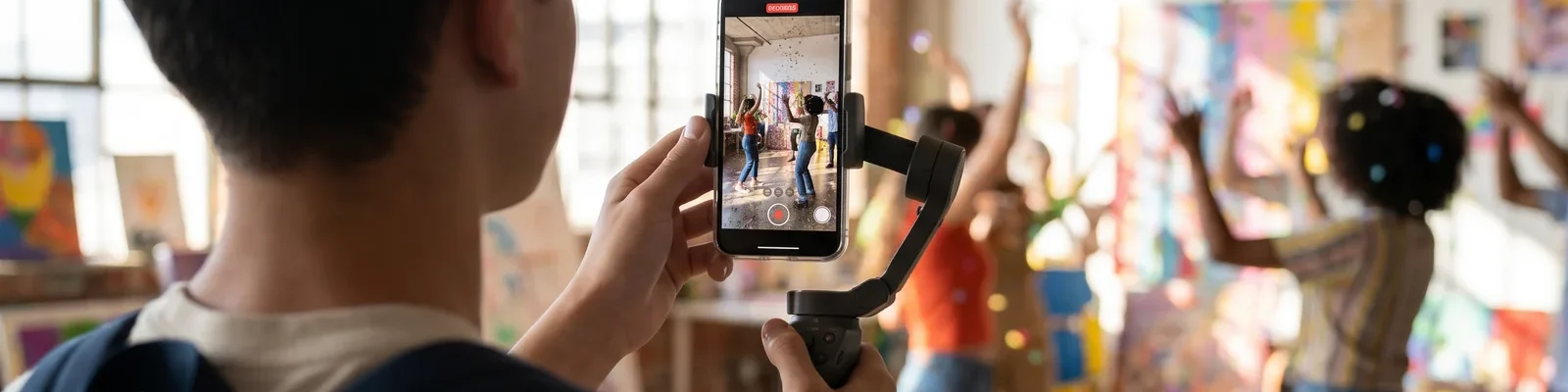
Going viral on TikTok looks like luck. It is not. The brands and creators who hit again and again are not luckier than everyone else, they are running a system. Here is how that system actually works in 2026, why most brand videos never leave the runway, and how to build content that the algorithm, and real people, choose to pass on. This is strategy, not a lottery ticket.
Virality is a system, not a lottery
The most expensive myth in social media is that going viral is random. It feels random because you only see the winners, never the hundred quiet posts behind them. But the accounts that go viral repeatedly are not pulling a slot machine. They have a repeatable process: a way to find ideas, test them cheaply, read the signals, and double down on what works.
That is the whole shift in mindset. Luck might get you one hit. A system gets you a habit. Everything below is how that system is built, starting with the thing almost nobody outside the algorithm actually understands: how a video spreads in the first place.
How a TikTok actually spreads
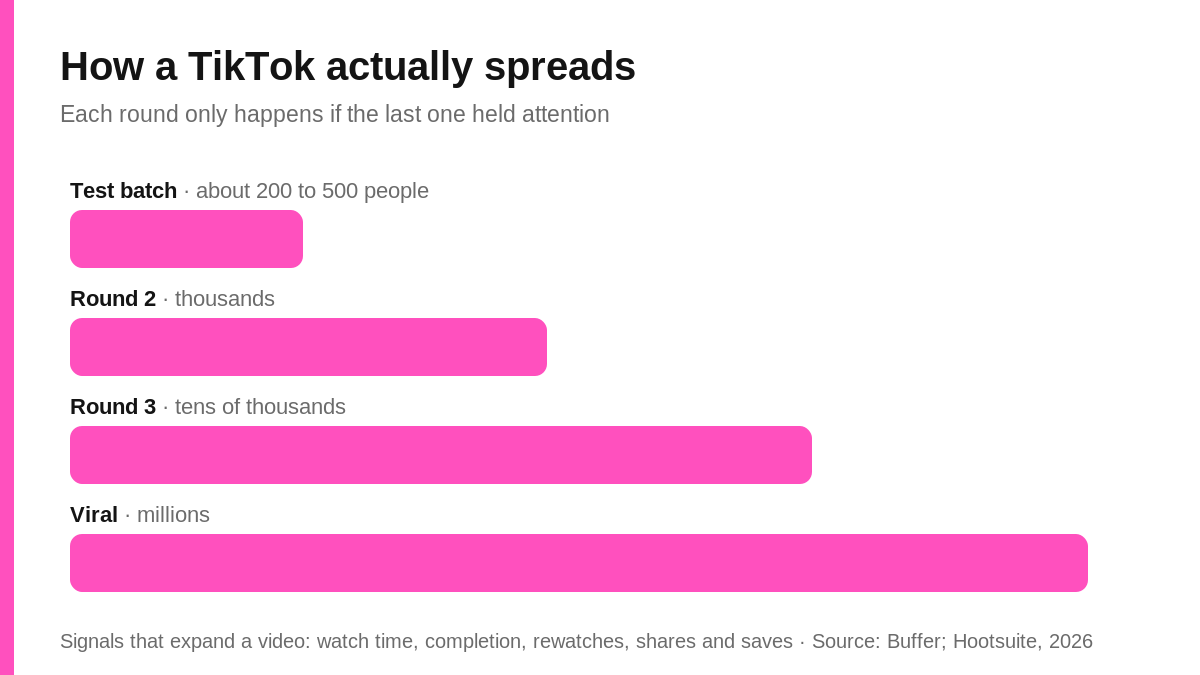
When you post, TikTok does not show your video to your followers and stop. It shows it to a small test batch, somewhere around 200 to 500 people, and watches how they react. Do they finish it? Rewatch it? Share it? If that batch responds well, the video is pushed to a bigger batch, then a bigger one, and that is what a “viral” video actually is: a clip that keeps clearing the bar, round after round (Buffer; Hootsuite, 2026).
This is why follower count barely matters on TikTok, and why a brand-new account can out-reach one with a million followers. You are not really posting to your audience. You are auditioning for the next batch. Understand that and everything else on this page starts to make sense.
The one metric that rules them all: watch time
If the batch system is the engine, watch time is the fuel. Completion rate, the share of people who watch to the end, is the single strongest signal TikTok uses in 2026 (Buffer; Hootsuite, 2026). Everything else is downstream of holding attention.
Then come the signals that really separate a hit from the pack. A rewatch is gold: one person watching your video three times is worth more than three people watching it once, and a clip that loops cleanly tells TikTok it is endlessly rewatchable. Shares and saves outrank likes, because they cost the viewer something, a share says “this is worth my reputation,” a save says “I want this later.” A like is cheap. A share is a vote.
So the goal was never “get likes.” It is get watched to the end, get watched again, and get sent to a friend. Design every video backwards from that.
You have under two seconds to earn the rest
People decide whether to stay or scroll in under two seconds. That makes the opening, the hook, the most important part of any TikTok by a distance. Get it wrong and the test batch bails, the video never expands, and the other 40 seconds you sweated over are never seen.
The hooks that work share three traits. They interrupt the pattern, something visual or verbal that does not fit the expected scroll. They open a curiosity gap, a question or promise the brain needs resolved. And they are specific, because a specific promise sets a clear expectation and earns the watch. Say it out loud and put it on screen, because plenty of TikTok is watched on mute. The hook is not the intro. On TikTok, the hook is the whole ballgame.
The hooks that actually earn the watch
If the hook is the whole ballgame, it is worth knowing the shots that land. A few patterns work again and again. The contrarian open (“everything you have been told about this is wrong”) that challenges an assumption. The specific promise (“three things we changed that doubled our reach”) that sets a clear, measurable expectation. The visual pattern-break, an unexpected motion, location or face in the first frame that the eye cannot ignore. The open loop (“wait for the last one”) that holds people to the end. And the relatable cold open that drops you straight into a moment, with no logo, no intro and no “hi guys.”
None of these are gimmicks. They all do the same job: earn the first two seconds honestly, then deliver on the promise so the watch time holds. A clever hook with nothing behind it just trains people to distrust your next one.
Why most brand videos never take off
Here is the uncomfortable part. Most brand TikToks fail for the same three reasons, and they are all self-inflicted. They make ads, not content. They chase a trend a beat too late, so the brand piling onto a sound everyone already used reads as try-hard. And they talk about themselves, when the feed is the one place nobody asked to hear from you.
TikTok is not a billboard, it is a conversation, and nobody wants an advert barging into it. The algorithm punishes low watch time, and the audience punishes anything that smells like marketing. Those two forces point in the same direction: stop selling, start being worth watching.
Ride trends, do not chase them
Trends are fuel, not a strategy. Used early, a rising sound or format gives your idea a tailwind. Used late, that same sound makes a brand look like it turned up to the party as everyone was leaving. The difference is timing and intent: jump on a format while it is still climbing, and only if you have a genuine angle that fits your brand. A trend is a vehicle for your idea, never a substitute for having one.
The brands that get this right treat trends as one input among many, not the whole plan. They keep a point of view, and borrow the format only when it serves it.
Make content, not ads, and let real people make it
The brands winning on TikTok do not run their TikTok like a TV channel. They make native content, the kind of thing a person would actually choose to watch, and they show rather than announce. A scrappy, real, phone-shot video routinely beats a glossy six-figure production here, because polish is not the currency. Attention is.
This is also why founder-led, employee-led and creator-led content outperforms the brand handle. Authenticity is the scarce asset in a feed full of perfect, AI-assisted everything, and a real human face beats a logo every time. It is exactly the territory our influencer and social team work in every day, and it is the same human-premium shift we wrote about in the future of content marketing.
Design for sound off and sound on
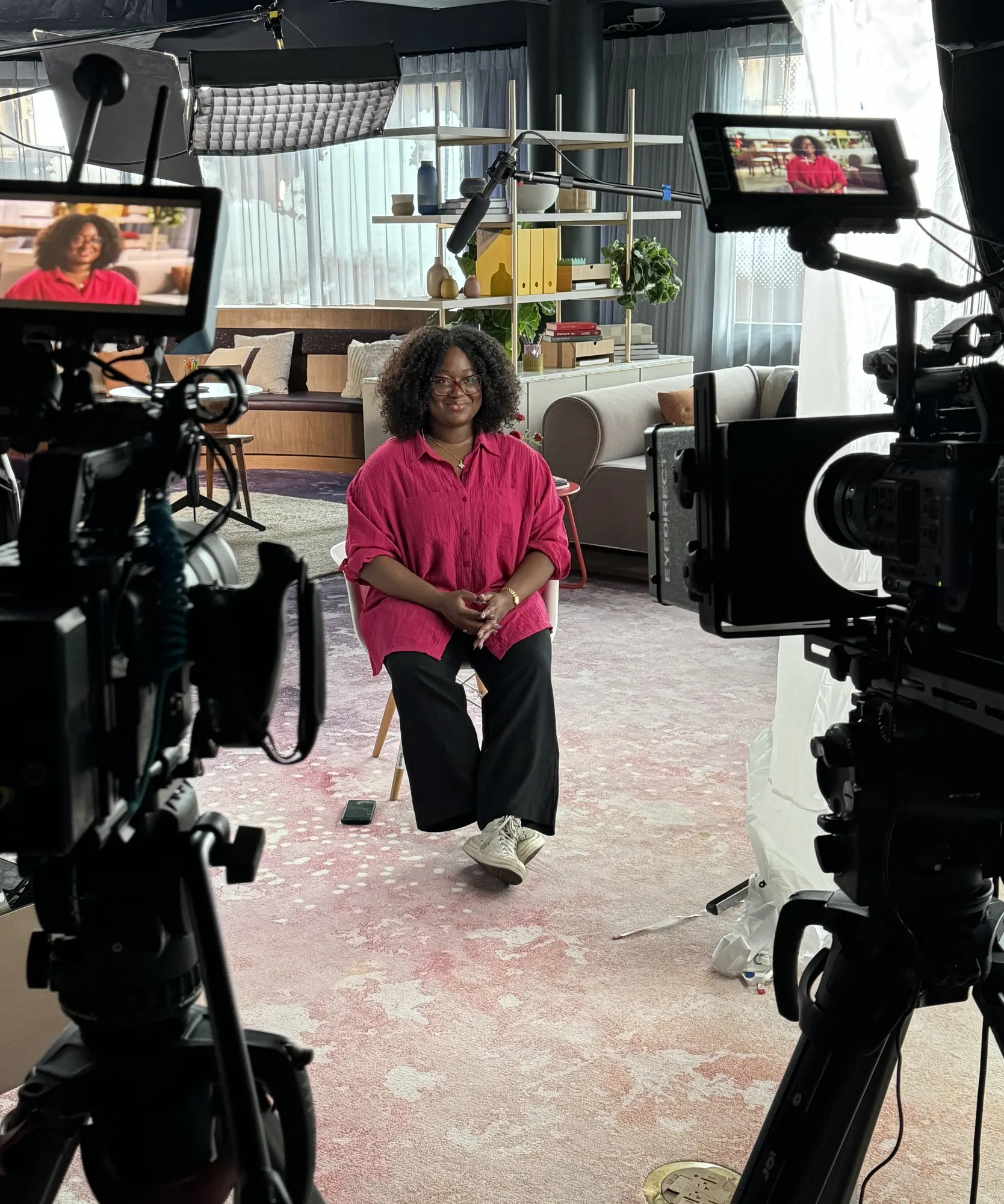
Two practical truths decide whether good content actually performs. A large share of feed video is watched on mute, so on-screen captions and text are not optional, they carry the message when the sound is off. But sound on TikTok is also a discovery engine in its own right, and the right trending audio can lift a video into more feeds. Build for both: captions so the muted majority still get it, and a considered audio choice so the algorithm has another reason to spread it.
We started our big TikTok push after I grabbed my phone to make a reactive piece for a client and could not even work the interface. It was embarrassing. So we got the whole team comfortable making simple work fast. We lowered the bar on polish and raised it on ideas, and that is when the viral hits started coming.
 Gulliver Moore
Co-Founder, Sunday Treat
Speed is an unfair advantage
One thing the data and our own experience agree on: speed wins. The teams that can spot a moment and ship a good video the same day, while it is still relevant, consistently beat the ones routing every idea through three rounds of approvals. Reactivity is a real competitive edge on TikTok, and it is one most big brands quietly hand away. You do not need a studio to move fast. You need permission to, a few reliable formats, and people who are comfortable making simple work quickly.
Going viral is not the goal
This is the part that separates a strategy from a stunt, and it is where premium brands should pay the most attention. Views are not the point. Business results are. A video with ten million views and the wrong audience, or no path to action, is an expensive way to feel good. Virality without strategy is a vanity metric in a party hat.
The real question is not “how do we go viral,” it is “how do we turn attention into customers.” That means matching the content to the audience you actually want, giving people a clear reason and a clear route to act, and pairing organic reach with paid amplification so your best-performing ideas get pushed to the right buyers, which is exactly what our performance marketing team does. Chase results, and the views become a means rather than the scoreboard.
What a real virality system looks like
Put it together and you get a machine, not a magic trick. The brands that go viral on purpose run four things in a loop. An ideation framework: a stable of angles, hooks and formats you can keep refreshing, so you are never staring at a blank page. A testing calendar: enough volume to learn quickly, without spamming. Feedback loops: you read what held attention and feed it straight back into the next round. And a refresh cycle: you kill formats the moment they fade, before the audience tells you to.
Volume, in this model, is how you learn, not how you win. You do not post 30 times because 30 is the magic number. You post to find the two or three ideas worth scaling, then you put real weight behind those. And you pick a foundational platform, get genuinely good there first, then adapt each idea for wherever else it lands, because an edit that flies on TikTok can die on YouTube.
The strategic test: if your TikTok plan would collapse the moment one video failed to pop, it is not a strategy, it is a bet. A system keeps working whether or not any single video goes viral.
What viral actually looks like: five campaigns that worked
Theory is cheap, so here are five brands that turned the principles above into real results, and the lesson worth stealing from each.
e.l.f. Cosmetics, #EyesLipsFace. e.l.f. spotted that sound drives TikTok and became the first brand to commission an original song for a challenge, then invited everyone to use it. It became the most viral campaign in US TikTok history, around five million user-made videos and billions of views, with celebrities joining unprompted and the track charting on Spotify (Shorty Awards; AdExchanger, 2020). The lesson: give people a format and a sound to play with, and let the audience make the content for you.
Duolingo, Duo the owl. Duolingo handed its team creative freedom, led with entertainment over education, and treats its comment section as the creative brief. The unhinged-mascot approach grew the account to tens of millions of followers at an engagement rate several times the brand average (Sprout Social; Rival IQ, 2026). The lesson: personality and reactivity beat polish. Make content people would choose, not ads they tolerate.
Stanley, the car-fire moment. When a user posted that her car had burned out but her Stanley survived with ice still inside, the clip passed 80 million views. Stanley’s president replied within two days, offered to replace her tumblers and her car, and that response alone drew tens of millions more views. Quencher sales rose around 275% year on year (GSD&M; HubSpot, 2024). The lesson: speed is the strategy. A fast, generous response to a real moment is worth more than any scheduled post.
Ocean Spray, the Dreams skateboard video. Ocean Spray did not make the video that defined it. A creator filmed himself skateboarding to Fleetwood Mac’s Dreams while swigging the juice, and it became one of 2020’s biggest TikTok moments, sending a 1977 song back to number one on iTunes (NPR; Marketing Dive, 2020). The brand could not manufacture the moment, but it rode it well, gifting the creator a cranberry-red truck and turning the clip into an ad. The lesson: some virality is earned, not made, so build the kind of brand people want to feature, and be ready to move the second they do.
Gymshark, community first. The British brand built on TikTok with raw, relatable content, long-term creator partnerships rather than one-off ads, and its 66-day Gymshark66 challenge, which shifts the focus from buying to doing. The hashtag has billions of views and a genuinely engaged community behind it (IIDE; Digital Agency Network, 2026). The lesson: a community that makes content with you is the most durable growth engine there is.
Notice what these have in common. Not one was a lucky fluke, and not one was an advert in the traditional sense. They are principles, sound, personality, speed, earned attention and community, executed with conviction. And the brands that turned views into real business results did so because there was a product and a plan waiting behind the moment.
What this means for brands in 2026
Here is our honest read. Stop buying lottery tickets and start building the machine. Obsess over watch time, not likes. Make content people would choose, not ads they tolerate. Hand the camera to real people. And measure customers, not views. The brands that treat TikTok as a system will keep winning, quietly and repeatedly, while everyone else waits around to get lucky.
We learned this the hard way on our own channel, and it paid off: 50 million plus views on Sunday Treat’s own TikTok in the first three months of 2026, and a win at The Drum Awards along the way. The data backs the direction too, as our video marketing statistics for 2026 show. If you want a hand turning this into a plan, our content production team makes the work. The tools and the trends will keep changing. The system, attention first, results always, does not. And we will, as ever, find the fun in it.
Want to go viral on purpose?
We are a London video and content agency, and a winner at The Drum Awards. Let’s build something worth watching, and worth sharing.
Get In Touch