By the time a SaaS buyer talks to your sales team, they have already decided most of what they think about you. They have watched your demo (or your competitor’s, if yours was hidden behind a form), skimmed a teardown on YouTube, and formed a view from thirty seconds of product footage on LinkedIn. That is the environment SaaS video marketing operates in now: the evaluation happens on screens you do not control, before conversations you never hear. This guide covers what actually works for SaaS and startup video in 2026, from demo videos and explainer-led funnels to product-led growth and the awkward reality of selling to a committee.
Your buyers would rather not talk to you
The single most useful stat in B2B right now: 67% of B2B buyers say they would prefer a rep-free buying experience, up from 61% a year earlier (Gartner, 2026). And even when they do engage sellers, buyers spend only about 17% of their total buying time meeting with potential suppliers, across all of them combined (Gartner). The rest of the journey is independent research: reading, comparing, and increasingly watching. Add the newest wrinkle, that 45% of buyers used AI tools during a recent purchase (Gartner, 2026), and the picture is clear. The evaluation now happens without you in the room.
Video is how you show up in a process you are not invited to. It is the closest thing to a sales conversation that can run at 2am in a tab you never see: the demo that answers “what does it actually do”, the founder clip that answers “who are these people”, the customer story that answers “will it work for someone like me”. For 15 years, video has been one of the most effective ways to communicate online, and B2B video marketing is simply that truth arriving late to software. The buyers got there first.
You are not selling to a person. You are selling to a committee
Gartner puts the typical B2B buying group at 6 to 10 decision-makers, each arriving with their own priorities and their own stack of independently gathered information (Gartner). Your champion might love you. But your champion now has to re-explain your product to finance, security, engineering and their boss, and they will do it without you present.
This changes what your videos are for. They are not just persuasion assets. They are forwarding assets: the two-minute product overview your champion drops into the Slack thread, the pricing-logic explainer that saves them writing a paragraph they might get wrong, the security walkthrough that answers the CISO’s first five questions. Make the videos your champion wishes they had, and you are effectively staffing the internal meetings you will never attend. It helps that video does this job faster than any document, and 70% of B2B buyers now engage with video content somewhere along their purchasing journey (Vidyard, 2025).
The demo video: your best salesperson never sleeps
The demo video is the hardest-working asset in SaaS marketing, and most companies still get it wrong in the same two ways: they gate it, and they let it sprawl. Gating first. If two-thirds of buyers prefer researching without a rep, a demo behind a “book a call” form is not lead capture. It is a door slammed in the face of your most convinced visitors, who will simply go and watch a competitor’s public demo instead. Ungate the main walkthrough. Capture intent with something worth trading details for, not with the basics.
Then length. Attention data is unambiguous: videos under one minute hold roughly 65% average engagement, and engagement falls as runtime grows (Wistia, 2026). The fix is not one long demo but a family of short ones: a 60 to 90 second overview for the curious, then tight two-minute chapters per workflow for the serious. Show the product doing something real inside the first ten seconds. Nobody needs your logo animation.
What’s so brilliant about video is it allows you to communicate in so many different ways, get a lot of information across in a short amount of time.
 Gulliver Moore
Co-Founder, Sunday Treat
That compression is the whole demo-video job description. A SaaS product is an abstraction, a database with opinions. Video is the only format that lets a stranger watch the abstraction become a solved problem in ninety seconds.
Explainer-led funnels: from “what is this” to signup
Where the demo shows the product, the explainer sells the problem, and SaaS funnels need both in the right order. The pattern that works: a short, punchy explainer at the top of the funnel that names the pain and reframes it (this is where animation earns its keep for software, because you can show the invisible: data flows, integrations, time saved). A product-focused demo in the middle. Customer proof near the bottom. One video per job, stitched by the journey.
The behavioural backing is strong: 96% of people have watched an explainer video to learn about a product or service (Wyzowl, 2026), and 91% of businesses now use video as a marketing tool, so the format is familiar to every buyer on the committee. We have broken down the formats, costs and conversion logic in our full guide to explainer videos, so here we will just say: a SaaS explainer video sells the problem, a product video shows the fix, and a case study proves it. The classic mistake is making one video try to do all three jobs at once. That video explains nothing, demos nothing and proves nothing.
Product-led growth needs video-led marketing
If your growth model is product-led, video is not a marketing extra. It is part of the product surface. Self-serve users hit friction without a human to call, and the difference between “activated” and “churned in week one” is often whether the right 40-second clip existed at the right moment: onboarding walkthroughs, feature announcements, “aha moment” shortcuts, changelog videos that make updates feel like momentum rather than release notes.
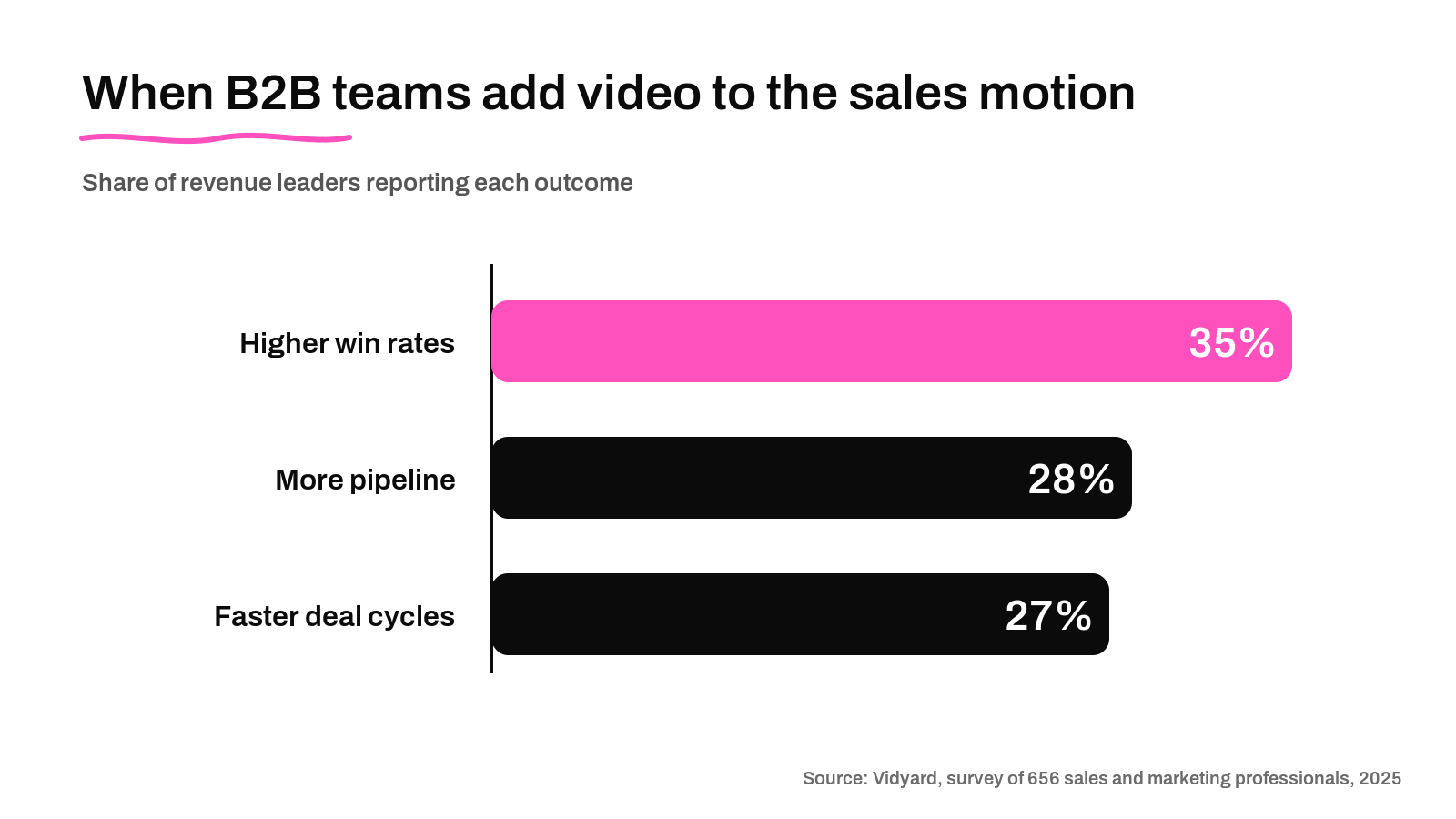
And the commercial upside of taking video seriously in the revenue motion is now measurable. Among revenue leaders using video, 35% report higher win rates, 28% report increased pipeline and 27% report shorter deal cycles (Vidyard, 2025, survey of 656 sales and marketing professionals).
Where SaaS video lives: LinkedIn, YouTube and, yes, TikTok
Channel choice for SaaS is refreshingly clear-cut. LinkedIn is now the default: 8 in 10 B2B marketing teams name it their primary place to share video (Wistia, 2026), and it is where your buying committee actually scrolls between meetings. YouTube is the depth library, home for demos, tutorials and the search traffic behind “how to do X”, where 94% of UK adult internet users already are (Ofcom, 2025). TikTok is the wildcard that keeps embarrassing sceptics: founder-led and behind-the-scenes content reaches younger decision-makers who take that scrolling habit into work. We would know. Sunday Treat is a B2B business, and treating TikTok as our foundational channel took our own account past 50 million views in the first three months of 2026.
The deeper principle is channel-first, not channel-everywhere: pick the platform your buyers actually use, win it, then adapt outward. That logic (and the framework behind it) is the spine of our video marketing strategy guide, and building it properly is exactly what our creative strategy team does for SaaS clients.
The startup video trap: copying enterprise B2B content because it looks “credible”. Your advantage as a startup is that a founder talking straight to camera about a real problem out-performs a faceless brand video every day of the week. Credibility is a person, not a colour palette.
Video inside the sales motion
Marketing does not own all the video value. Sales teams using video for outreach see response rates rise, with more than 60% of reps reporting improved reply rates from video messages (Vidyard, 2025). A 45-second personalised walkthrough of the prospect’s actual use case beats another “just bumping this” email by an unfair margin. The same asset library that powers marketing (short demos, feature clips, customer stories) makes every rep faster, and roughly 20% of viewers who encounter a lead-capture form inside a video go on to complete it (Wistia, 2026).
For startups, this is also the cheapest place to start: one competent setup, a quiet corner of the office, and a rep who knows the product cold. No agency required. Save the budget for the assets that need craft.

One practical note on tone, because software teams overthink this. The buyer watching a sales video is not grading your production values. They are checking whether you understand their problem and whether your product genuinely solves it. Specificity is the production value: their industry, their workflow, their data in the frame (with permission, obviously). A slightly scruffy video that nails the use case will outperform a beautiful generic one every single time, which is convenient, because scruffy and specific is also faster to make.
What it costs, and how fast it moves
Speaking of budget: professional production for SaaS typically runs anywhere from around 5,000 GBP for a focused social-first package to six figures for full campaigns, with most of the work we produce landing in the 10,000 to 40,000 GBP range. Timelines are shorter than founders expect: roughly three weeks of pre-production and two weeks of post is a normal rhythm for a planned shoot, and a well-designed production day generates families of assets rather than one film. A single Revolut campaign with Grace Beverley produced 50 deliverables, which is the kind of maths that makes video economics work for a subscription business: one budget, a quarter’s worth of content across the funnel.
Then let performance data decide what gets scaled. When an organic clip proves it can hold attention, that is the asset that earns paid distribution, and our performance marketing team runs precisely that loop: creative first, spend behind evidence.
Want SaaS video that moves pipeline?
We are a London video and content agency, and a winner at The Drum Awards. We plan, make and scale video for software brands, from explainer to demo to paid.
Get In TouchThe SaaS video marketing playbook for 2026
Good SaaS video marketing is a system, not a showreel. Ungate the demo and keep it under two minutes. Build one video per funnel job: explainer for the problem, demo for the product, customer story for the proof. Arm your champion with forwardable clips the committee can absorb in five minutes. Put video inside the product if you are product-led, and inside the sales motion regardless. Make LinkedIn the distribution spine, YouTube the library, and give founder-led short-form an honest try before dismissing it. Start scrappy, upgrade the assets that prove they matter, and measure everything against pipeline rather than views.
None of this needs a Hollywood budget. It needs the discipline to treat video as the sales conversation your buyers actually wanted: short, specific and available without asking permission. Get that right and the committee does your selling for you. And if you would like a team that has made this work for fintechs, apps and B2B brands to build it with you, we are easy to find, and we will find the fun in your product too.
