Nobody has ever briefed us for a boring explainer video. And yet the internet is heaving with them: the same whiteboard hand, the same jaunty ukulele, the same “meet Sarah, Sarah has a problem” script. The format gets ordered by the metre because it works, and the numbers back that up. 96% of people have watched an explainer video to learn more about a product or service (Wyzowl, 2026). So before you call an explainer video company and ask for “one of those”, here is what actually converts, what it costs, and the five types worth choosing between.
What an explainer video actually is
An explainer video is a short video, usually 60 to 90 seconds, that does one job: it makes someone understand what you offer and why it matters to them. That is the whole brief. Not your founding story, not your seventeen features, not the awards shelf. One clear problem, one clear answer, one clear next step.
Most live on landing pages and product pages, where the buying decision happens, then get cut down for social, ads and sales decks. The best ones earn their keep for years. And because the format is so tightly defined, the difference between a forgettable explainer and a brilliant one is almost never the length or the budget. It is the idea.
Why explainer videos convert
Explainers convert because they remove the two things that kill a sale: confusion and effort. When Wyzowl asked people how they would most like to learn about a product or service, 63% said a short video, which beats every other format on the list. People do not want to read your documentation. They want to watch something that respects their time.
The conversion evidence is unusually consistent. 85% of people say they have been convinced to buy a product or service by watching a video, and Wyzowl’s analysis puts the conversion lift from adding an explainer to a landing page at up to 80% (Wyzowl, 2026). On the marketer side, 93% say video has increased user understanding of their product, and 83% say video has directly increased sales (Wyzowl, State of Video Marketing 2026).
That is why 68% of video marketers made explainer videos last year, making it the second most common use of video after social content (Wyzowl, 2026). It is one of the highest-intent placements in marketing: the viewer has already arrived at your page wanting to understand you. The explainer just has to not waste the moment. If you like this sort of evidence, our roundup of video marketing statistics for 2026 has a full bank of it.
The 5 types of explainer video (and when to use each)
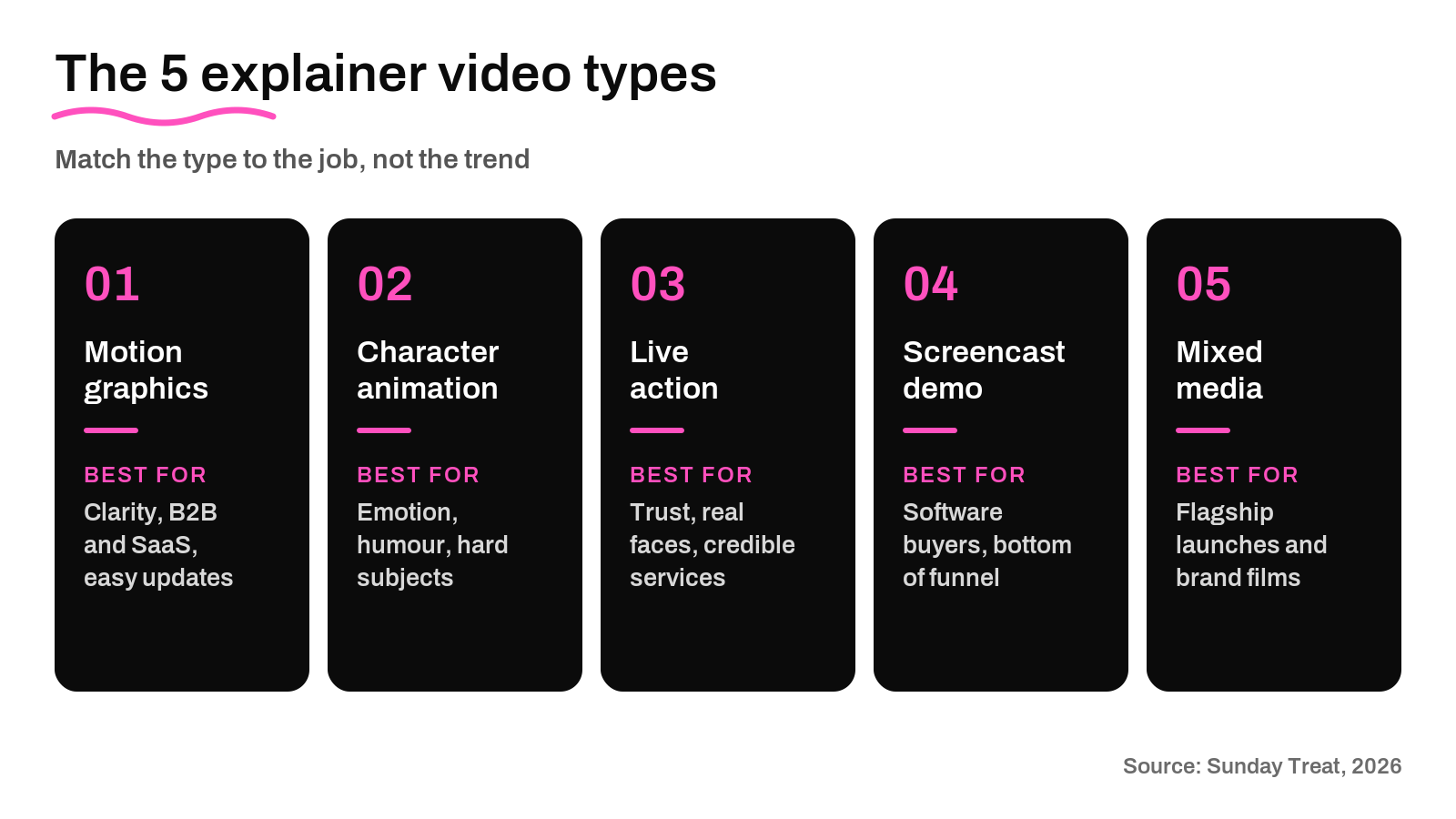
“Explainer” describes the job, not the style. These are the five types of explainer video we actually make for clients, and the situations where each one earns its place.
1. Motion graphics explainer
Kinetic type, moving shapes, animated icons and data, usually built in After Effects. This is the workhorse of B2B and SaaS because it makes abstract things visible: platforms, processes, integrations, anything without a physical product to point a camera at. It is also the most efficient type to update, because when your pricing, interface or messaging changes, an animator swaps the assets rather than rebuilding the film. Choose it when clarity is the priority and your subject is an idea rather than a person. A basic 60-second motion graphics piece starts around $1,000 to $5,000, rising with craft (Vidico, 2026).
2. Character animation explainer
Illustrated characters acting out the story. Harder to do well than motion graphics, because bodies and acting need a different level of animator, but it buys you emotion and memorability that icons cannot. Characters carry humour, empathy and awkward subjects brilliantly. There is hard evidence for the approach too: System1 found campaigns built on a recurring brand character are 37% more likely to grow market share, yet only around 4% of US ads use one. Choose character work when you need people to feel something, or when the topic is sensitive and a real face would be too much.
3. Live action explainer
A real person, on camera, explaining the thing. Founders, customers and product specialists build trust in a way no illustration can, which suits services bought on credibility: finance, healthcare, professional services. It also suits products whose texture matters, food and drink especially, where the real thing sells harder than a drawing of it. The trade-off is flexibility. If the product, the pricing or the presenter changes, you reshoot rather than re-edit. Our video production team usually pairs a live action explainer with cutaway graphics so the facts stay easy to update while the human stays on screen.
4. Screencast and product demo
The product, shown honestly, with a guided tour of the exact screens a user will meet. Unfashionable, cheap, and for bottom-of-funnel software buyers, often the highest-converting thing on the page, because it answers the only question that matters: what is it actually like to use? Choose it when your interface is genuinely good and your buyer is comparison shopping. Polish it with motion design so it does not feel like a training video from 2011.
5. Mixed media explainer
Live action with animation woven through it: graphics over footage, illustrated sequences inside real scenes, type that reacts to the world. You get human trust and animated clarity in one film, which is why some of the work we are proudest of sits here. It needs planning before the shoot rather than after, and it costs more than either ingredient alone. Choose it for flagship placements, launches and brand-level explainers where you want the thing to feel unmistakably yours.
I think explainer videos can be really dull, and there’s a real joy in subverting the expectation and making them fun.
 Gulliver Moore
Co-Founder, Sunday Treat
What separates a converting explainer from wallpaper
The difference is nearly always decided before anyone opens an animation package. A few rules we hold to, learned the useful way.
Say one thing. The explainers that die are the ones carrying six messages because six stakeholders each added a line. The script is the product: 150 words for a 60-second film, written for the ear, read aloud until it sounds like a person. Earn the first five seconds, because the drop-off curve is brutal and nobody owes you their attention. Show, don’t narrate; if the visuals just illustrate the voiceover word for word, you have made an audiobook with pictures. And end with one action, not three.
Then find the angle nobody expects. The subject matter is never the ceiling. We made an animation for the NHS about what happens after an unusual death, a subject you could not film and would not want to, and illustration gave it the warmth and care the audience needed. That is the point of the craft: the drier or harder the topic, the more an unexpected, human treatment stands out. Boring is a choice, and it is always the wrong one.
And do not neglect the sound. Music, voice casting and sound design carry half the personality of an explainer, yet they are usually the last line in the budget. A warm, well-cast voice makes a brand feel like a person. A stock ukulele track makes it feel like everyone else.
Where to put an explainer video (and how to judge it)
The classic home is the landing page, close to the fold, where the up to 80% conversion lift lives. But one film should never stay in one place. The same core explainer earns its budget again as a pinned social post, a paid ad cutdown, the first email in a sales sequence, a trade-show loop and the top of your onboarding flow. Each placement needs its own edit, because a film made for a landing page will not survive a TikTok feed unchanged. Make it for the platform it lives on, always.
Judge it on the right numbers, too. Views flatter everyone and mean almost nothing. The metrics that tell you whether an explainer works are watch-through rate (are people still there at the call to action?), conversion rate against the page’s pre-video baseline, and what your sales team hears on calls. When prospects arrive already understanding the product, the video is doing its job, and that shows up in shorter sales conversations long before it shows up in a dashboard. With 92% of marketers planning to hold or raise video spend in 2026 (Wyzowl), the brands measuring properly will be the ones spending it well.
Want an explainer people actually watch?
We are a London animation and video agency, and a winner at The Drum Awards. See our animation work, then tell us what you need explaining.
Get In TouchWhat an explainer video costs
Honest numbers, because vague ones waste everyone’s time. Industry benchmarks put a standard 2D animated explainer video at $3,000 to $15,000, with character-led and premium work above that (Vidico, 2026). Our own projects run from around £5k for something simple to £200k for a full campaign, and the sweet spot where most brands get the best value sits between £10k and £40k.
Explainer video cost is driven by three things: the style (character animation and mixed media cost more than motion graphics), the length (shorter is cheaper, and usually better), and the number of revision rounds your sign-off process really needs. That last one is the quiet budget-killer. Every stakeholder who joins after the storyboard stage adds cost, so agree who signs off before anything moves.
Timeline-wise, allow roughly three weeks for pre-production, where the script and storyboard get locked, and around two weeks of post and polish. Rushing the first half to save time is how expensive mistakes get animated.
How to choose an explainer video company
Three tests sort a real explainer video agency from a template farm. First, range: if every film on the showreel looks the same, you are buying their house style, not an answer to your brief. Second, process: good studios lock script, then storyboard, then an animatic before full animation, so you see exactly what is coming and never pay to change finished frames. Third, questions: the right partner interrogates your audience and your one message before quoting, which is creative strategy work, not an upsell. If a company quotes a price before asking what the video needs to achieve, keep walking.
Do explainer videos still work in 2026?
Better than ever, with one caveat. AI tools have made average explainers effectively free, which means the internet is about to drown in them, and “fine” has stopped being worth publishing. The winners will be the brands whose explainers have a genuine idea, a distinct style and some human wit in the writing, the things a template cannot generate. We have written about where AI is taking animation in more depth, but the short version is this: the format is not tired. The lazy version of it is.
With 91% of businesses now using video and 82% of marketers reporting good ROI from it (Wyzowl, 2026), the question is not whether an explainer belongs on your page. It is whether yours will be one of the few people remember. That part is a choice. Find the fun, and the conversions tend to follow.
