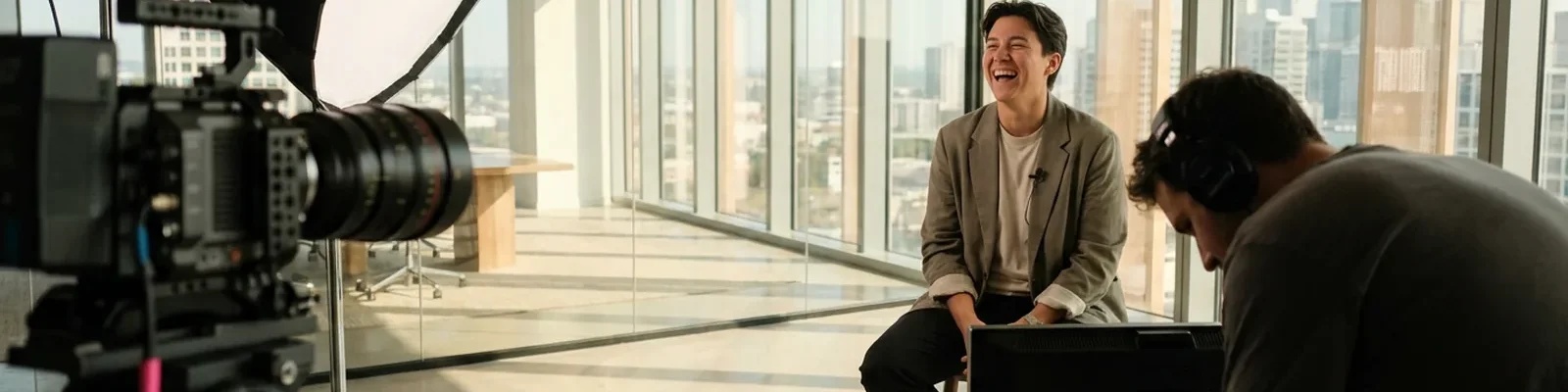
Say “corporate video” and most people picture the same thing: a slow drone shot of an office, some handshakes, a voiceover saying “innovation”. We have made hundreds of corporate films for brands like the NHS, NatWest, McKinsey and Google, and here is our honest position: corporate video production only feels boring when it is bought and made carelessly. This guide covers what corporate video production includes, the eight types and when to use each, what it costs, and how to choose an agency that makes work your audience will actually watch.
What corporate video production actually covers
Corporate video production is the strategy, filming, animation and editing of video made for an organisation’s business goals rather than for entertainment: telling the brand story, communicating with staff, recruiting, training, launching products and building trust with buyers. If a company commissions it and it is not a pure ad campaign, it usually gets filed under corporate video.
It is also no longer a niche purchase. 91% of businesses use video as a marketing tool, and 82% of marketers say it delivers a good return on investment (Wyzowl, 2026). UK video budgets swung back into growth in Q1 2026 with a net balance of +5.7% of companies increasing spend (IPA Bellwether, 2026). And for B2B brands the distribution picture has quietly flipped: 81% of teams now share video on LinkedIn, making it the number one B2B video channel, ahead of YouTube at 76% (Wistia, 2026).
In other words: your next corporate film will probably be watched on a phone, in a feed, by someone who did not plan to watch it. People now spend around 2.5 hours a day watching YouTube and TikTok alone (DataReportal, 2026), so the attention is there in vast quantities. It has just stopped waiting politely for companies to finish their preamble. That single fact should shape everything you commission.
The eight types of corporate video (and when to use each)
Different jobs need different films. These are the eight types of corporate video we get asked for most, and what each one is actually for.
- Brand film. The cinematic centrepiece: who you are, why you exist, what it feels like to work with you. Best commissioned at a brand moment (rebrand, milestone, funding round). We wrote a full guide to the brand film if that is the job in front of you.
- Internal comms video. Strategy updates, change announcements, town halls and CEO messages. An internal comms video earns its keep when the message matters too much to trust to an email nobody opens.
- Recruitment and culture film. Shows candidates the real people and the real office, not the stock-photo version. The honest ones outperform the polished ones, every time.
- Training and onboarding video. Repeatable, consistent and measurable. One good training film replaces a hundred repeated workshops, and clear chaptered video is far easier to maintain than a PDF nobody reads.
- Product and explainer video. Shows what the thing does and why anyone should care. 96% of people have watched an explainer video to learn about a product (Wyzowl, 2026). Animated explainer videos are often the most cost-efficient route here because there is no shoot at all.
- Customer testimonial and case study film. Your happiest customer saying what you cannot say yourself. This format is surging: 47% of companies plan to make testimonial videos this year, up from 17% in 2023 (Wistia, 2026).
- Event video. Conference films, panel edits and social cutdowns that make one day of content last a quarter.
- Executive and social content. Short, regular, feed-native clips of your leaders and experts saying useful things. The cheapest trust-builder on this list, and the one most companies still skip.
Two buying notes. First, most organisations need three or four of these over a year, which is why a rolling production partner usually beats commissioning each film cold. Second, product videos and webinars are the formats teams rate as having the biggest business impact (Wistia, 2026), so if you are prioritising with a limited budget, start where the revenue is.
And within several of these types you have a second choice to make: live action or animation. Filming real people buys authenticity and trust, which is why testimonials and culture films should almost always be shot. Animation buys clarity, consistency and easy updates, which is why training and product content so often suits it. Plenty of the best corporate work mixes the two. We compared the options properly in our guide to motion graphics vs live action, so if that fork is in front of you, start there.
What does corporate video production cost?
Most professional corporate videos in the UK cost between £5,000 and £40,000. Interview-led films with a small crew sit at the lower end, while multi-day, multi-location productions with actors and long deliverables lists climb toward £100,000 and beyond. Across all our work the sweet spot is £10,000 to £40,000, and corporate video cost behaves exactly like every other production cost: it is driven by crew, kit, shoot days, post-production and usage.
We priced all of this out properly, band by band and day rate by day rate, in our UK video production cost guide. Read that before you set a budget; it will save you a fortnight of confusing quotes. The short version: decide the budget first, share it with your agency, and insist on an itemised breakdown so you can see where every pound goes.
Need corporate video that does not feel corporate?
We make films for the NHS, NatWest, Google and McKinsey that people watch by choice. Drum Award winning, budget transparent, genuinely fun to work with.
Get In TouchWhat separates a good corporate video agency from a competent one
Plenty of production companies can expose a frame correctly. That is table stakes. The difference shows up in two places: how much the agency cares about the creative, and what it is like to spend six weeks working with them. Gully’s definition is the one we run the company on.
A good video production company is one that really cares about the creative and also is a joy to work with. I feel like there’s the two aims that we have. 50% of it is making really great work that achieves our client’s objectives. And 50% of it is making sure that our client has a great time whilst we do that.
 Gulliver Moore
Co-Founder, Sunday Treat
That second 50% is not fluff, and it is not just about being pleasant. It means the client understands every part of the production process, knows exactly what will unfold on the shoot day, and is never surprised by an invoice. Corporate projects involve real risk: talent contracts, locations, compliance sign-off, filming in workplaces where sensitivities matter. A lot can go wrong when corners get cut, which is why serious work deserves an agency with real processes behind the charm. (Ours have been sharpened by every mistake we have ever made. The same one never happens twice.)
When you are choosing a corporate video agency, ask three questions. Can I see work they made for an audience like mine, and did I watch it to the end? Will they show me an itemised budget without being asked twice? And who exactly will be on my project, because if the founders or senior team vanish after the pitch, that tells you how it will go. Awards help too as an independent signal (we are a winner at The Drum Awards), but the showreel and the cost sheet tell you more.
How the production process works (and how fast it can go)
Every corporate project moves through the same four stages: brief, pre-production, shoot and post-production. You set the direction with a clear one-pager (we published our exact video agency briefing template), the agency plans the job properly (creative, locations, casting, risk assessments and insurance), the shoot itself is usually one or two days for most corporate films, and the edit turns the material into every asset on the deliverables list.
A properly planned project wants around three weeks of pre-production and two weeks of post. But speed is possible when the machine is well drilled: for Asda’s “Pop the Bublé” campaign we turned around 16 assets in 10 days. The difference between fast and chaotic is decisiveness on both sides, which is why we ask every client to name their sign-off people before the shoot, not after it.
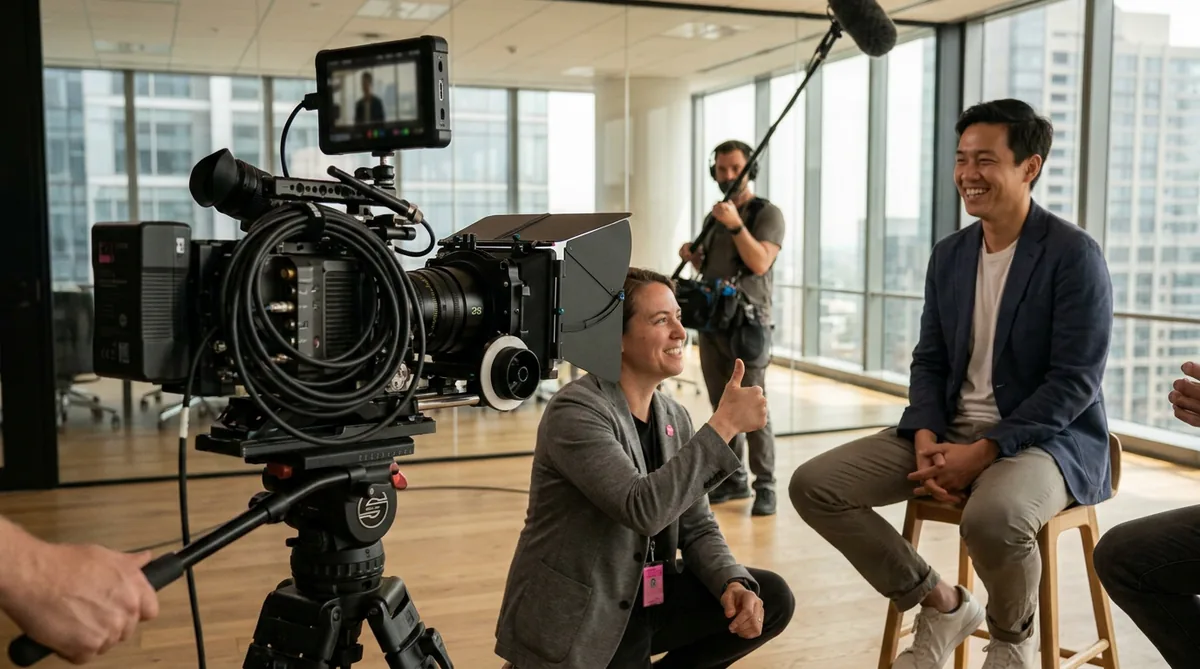
Here is the standard we hold ourselves to, and the one you should hold any agency to. If you are attending your own film set, you should know exactly what is going to unfold before you arrive, because every creative decision was made with you in the room during pre-production. No surprises, no “we will figure it out on the day”. Everyone’s time on set is expensive and finite, from your comms director to the camera assistant, and a shoot that respects that runs calm, wraps on time and produces better material. If an agency’s plan for your shoot day sounds improvised, the budget will behave the same way.
One more planning note: think in deliverables, not “a video”. A single corporate shoot can feed your website, LinkedIn, internal channels, recruitment pages and events for months if the cutdowns are planned from day one. That is where the 76% of companies now publishing at least one video a month (Wistia, 2026) are getting their volume: not from more shoots, from smarter ones.
The white-label route for agencies
If you are reading this from inside another agency, there is a quieter way to buy all of the above. Plenty of creative, PR and digital agencies sell corporate video to their clients and partner with a production team behind the scenes to deliver it. We run exactly that model through our white-label video production service: your client relationship, your brand on the deck, our crew and post-production doing what we do. It is how a ten-person agency credibly offers a fifty-person capability, and around a quarter of companies already outsource video production rather than building in house (Wistia, 2026), so nobody blinks. Capacity flexes with your pipeline too: you win the retainer first and staff it second, without a single new hire.
How to make corporate video people actually watch
The bar is brutal. Your film is competing with everything else on the platform where it lands, and 94% of UK adult internet users are on YouTube alone (Ofcom, 2025). Nobody owes a corporate film their attention. You earn it the same way every other video earns it.
Three principles do most of the work. Lead with people, because faces, stories and little human moments hold attention where logos and mission statements lose it. Make it for the platform it lives on: a two-minute 16:9 film for the website, a 30-second vertical cut for the feed, captions everywhere. And find the fun. Even the driest subject has a human angle, a surprise or a moment of honesty in it somewhere, and that moment is the difference between “watched” and “completed”. It is literally the philosophy our agency is named for, and it applies to a pension provider’s internal comms exactly as much as a snack brand’s TikTok.
Corporate video production is not a commodity purchase, however hard the market tries to treat it as one. Pick the right type for the job, budget with your eyes open, brief it on one page, and work with a video production team that treats “corporate” as a client type, not a style of filmmaking. Dull is optional. It always was.
For the bigger picture, start with our video marketing strategy guide.
