
Somewhere right now a marketing team is having the same argument: half the room wants a film crew, the other half wants a motion graphics agency, and the deadline does not care either way. It is a real decision with real trade-offs in cost, timeline and what the audience feels. So here is the working framework we use with clients, starting with the honest side-by-side, because if you only read one thing, read the table.
| Motion graphics | Live action | |
|---|---|---|
| Best for | Abstract subjects: software, data, processes, ideas | People, places, products with texture, emotion and trust |
| Cost per finished minute | Roughly £1,500 to £6,000 in the UK (Media Village, 2026) | Roughly £800 to £1,500 simple, £1,500 to £3,000+ for brand work (Media Village, 2026) |
| Timeline | Typically 3 to 6 weeks, no shoot logistics | Around 3 weeks pre-production, the shoot, then about 2 weeks of post |
| Updates later | Cheap: swap assets, re-render | Expensive: reshoot or work around it |
| Biggest risk | Feeling generic without strong design | Shoot-day variables: weather, talent, locations |
| Shelf life | Long, style-dependent | Long, unless people or products change |
What motion graphics actually is
Motion graphics is animated graphic design: kinetic type, moving shapes, charts, icons and interface elements, usually built in After Effects by animating assets that already exist. That last part is the key distinction people miss when they ask about motion graphics vs animation. All motion graphics is animation, but not all animation is motion graphics: character animation, where drawn bodies have to move and act believably, is a different craft with a different skill level of animator behind it, and it is priced accordingly.
Good motion design does two jobs at once. It explains, because shapes and type can show a process or a data story with total control over where the eye goes. And it brands, because every frame is built from your colours, your type and your visual system, which makes consistency across a campaign almost automatic. That control is why so much B2B, SaaS and finance work leans this way. There is no weather on a motion graphics project. No release forms either.
The under-rated superpower is change tolerance. When a price, a product name or a compliance line moves, a motion graphics film gets opened, amended and re-rendered in days. The same change in a filmed piece means a reshoot, a crew, and a diary full of people who have moved on. If your content has a shelf life measured in quarters rather than years, that difference alone can decide the format.
What live action gives you that graphics cannot
A face the viewer believes. Live action video buys you the things design cannot fake: a founder’s conviction, a customer’s honest hesitation before they say the nice thing, the texture of a product in real hands, the atmosphere of a real place. Buying decisions run on trust, and 85% of people say a video has convinced them to buy (Wyzowl, 2026); the videos doing that convincing are overwhelmingly ones with humans in them.
Live action is the right default when what you sell is people (services, hospitality, anything founder-led), when the product’s physicality is the point, or when the brief is emotional at brand level, the territory of the brand film. The cost structure is different rather than automatically higher: a small UK crew starts around £800 to £1,500 a day (Media Village, 2026), and a simple interview-led piece can land cheaper per minute than premium motion design. What live action really costs is logistics and immovability. Once it is shot, it is shot.
Cost and timeline, honestly
UK benchmarks put simple live action around £800 to £1,500 per finished minute, rising to £1,500 to £3,000+ for brand and commercial work with locations, talent and complex edits, while animated and motion graphics content typically runs £1,500 to £6,000 per minute (Media Village, 2026). US benchmarks tell the same story with wider spread: a basic 60-second motion graphics piece costs $1,000 to $5,000, premium motion design reaches $8,000 to $15,000+ per minute, and mixed media sits anywhere from $2,000 to $30,000+ depending on the filmed-to-animated balance (Vidico, 2026).
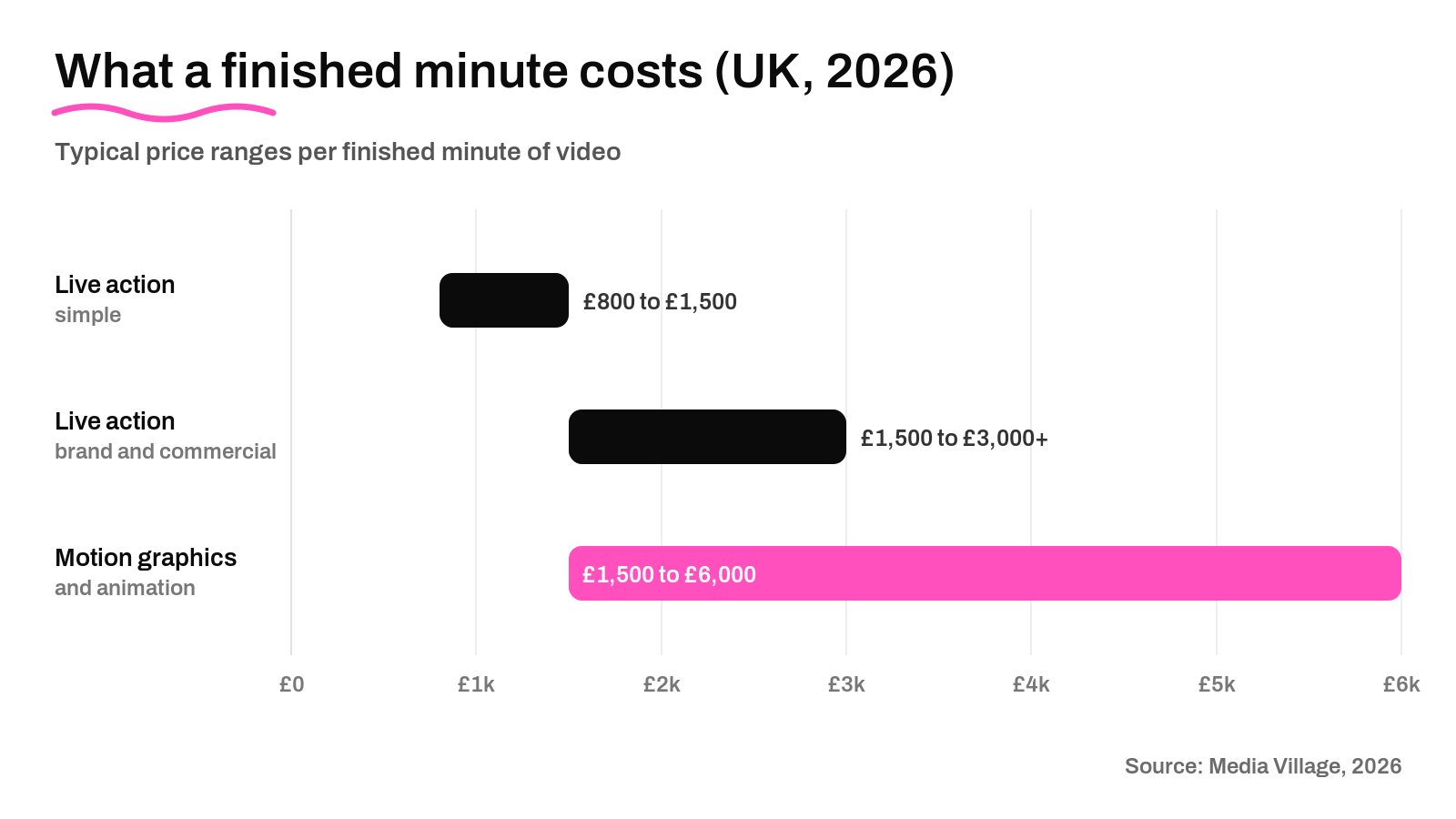
Our own projects run from around £5k to £200k across both formats, and the sweet spot where most brands get the strongest work for the money sits between £10k and £40k. On timelines, a standard live action job runs roughly three weeks of pre-production and two weeks of post, and our fast turnaround is about 10 working days over two weeks. Motion graphics compresses differently: no shoot to schedule, but design development needs its own runway, and skipping it is how projects end up looking like a template. The formats’ costs overlap far more than the stereotype of “animation is the cheap option” suggests. What differs is where the money goes: live action spends it on the day, motion graphics spends it on the craft hours before delivery.
When to use motion graphics
Wondering when to use motion graphics? Choose it in five situations. When the subject is abstract, because you cannot film an API, a pension or a data pipeline, and diagrams that move are the clearest explanation humans have invented. When the content will change, because pricing, features and stats date fast, and swapping an animated asset costs a fraction of a reshoot. When you need volume across a system, one style guide feeding twenty assets. When the budget cannot carry shoot logistics but the work still has to look premium. And when the brand system itself is the star, in the tradition of title design and the best B2B work. If the job is explaining a product, this is usually the answer, and our guide to explainer videos and the five types that work goes deeper on that specific decision.
When to use live action
Choose live action when a human needs to be believed: testimonials, founder stories, culture and recruitment films, anything where sincerity is the product. Choose it when texture sells, food, fabric, machinery, spaces. Choose it when you want borrowed reality, a real event, a real crowd, real scale. And choose it when the emotional bar is high, because for all that animation can be moving, nothing lands like a person on camera meaning what they say. This is the craft our London video production team lives in, and the discipline that makes it work is unglamorous: casting, location scouting and a shot list that has already imagined the edit.
We also integrate animation into live action a lot… it’s always really important to think about how you’re going to integrate it before the shoot, how you’re going to make space within the live action footage for that animation material to come in and really be as effective and beautiful as it can be.
 Gulliver Moore
Co-Founder, Sunday Treat
The third option most briefs ignore: mixed media
The strongest answer to “motion graphics or live action” is often “yes”. A mixed media video puts animation inside footage: type that reacts to the world, illustrated sequences carrying the abstract sections, graphics giving a filmed story its data spine. You keep the trust of real humans and gain the clarity of design.
The catch is in Gully’s line above: it has to be planned before the shoot, not sprinkled on in post. The camera must leave space, physically and rhythmically, for the animation to live in. Done properly the result can be remarkable. Our film with PR agency Kindred set original footage, stock and archival material under an animated visual world, all carrying a poem written and read by Poet Laureate Simon Armitage about the probation service, and the blend is exactly why it works: no single format could have held that story. Budget honestly for it though, because you are paying for two crafts and the planning that joins them, which is why mixed media spans such a wide range, from $2,000 to $30,000+ per minute (Vidico, 2026).
What the choice looks like on real campaigns
Abstract frameworks are easier to trust with real examples attached, so here are three from our own slate.
When Lipton wanted festival campaign content with genuine human energy, no animation style on earth could have replaced real performers spraying a real crowd with water cannons in the Portuguese sun. That live action campaign, the SLURP Squad, reached 149 million impressions, and every one of them was earned by things that actually happened. Compare that with a fintech or SaaS launch, where the product is pixels and policy: there we build a motion design system, one set of style frames feeding launch film, product explainers, paid cutdowns and event screens, so the twentieth asset ships as on-brand as the first. And when Asda needed 16 assets in 10 days for “Pop the Bublé”, the deciding factor was neither aesthetics nor emotion but the calendar, which is a perfectly legitimate way to choose a format. Deadlines are creative constraints too.
Notice what decided each one: the subject, the shelf life and the schedule. Not taste, and never “which is cheaper” in the abstract, because as the table shows, the ranges overlap too much for that question to have a general answer.
The five-question decision framework
Run your brief through these in order and the answer usually falls out by question three.
1. Can you point a camera at the subject? If what you sell is invisible, motion graphics. If it photographs beautifully, live action just went ahead. 2. Does trust depend on a face? If a human saying it is the persuasion, film the human. 3. How often will the content change? Quarterly updates mean animation, because re-rendering beats reshooting every time. 4. What can the budget and calendar genuinely carry? A shoot needs crew, kit, locations and contingency; motion graphics needs craft hours. Under about £10k and a tight deadline, motion graphics usually protects quality better. 5. Where will it live? A TikTok-first campaign wants native-feeling footage more than polished graphics; a product page wants clarity; a keynote screen wants design. Make it for the platform it lives on.
And if the scores tie, our defaults: selling software, choose motion graphics. Selling people or places, choose live action. A flagship brand moment with budget behind it, mix them on purpose. Sitting on the fence costs more than either option, because a film that half-commits to both crafts usually achieves neither.
Still arguing about which one?
Send us the brief. We are a London video and animation agency, a winner at The Drum Awards, and we make both, so our answer will be the honest one.
Get In TouchWhat to expect from a motion graphics agency
If the framework points you to graphics, here is what a good motion graphics agency should walk you through, in order: a creative brief that nails the one message, style frames that set the look before anything moves, a storyboard, then an animatic (the rough moving version where timing gets fixed), and only then full animation. Every stage is a cheap place to change your mind, and each one after it gets more expensive, so a studio that rushes you past style frames is quietly transferring risk onto your budget. Ask to see range in the portfolio too. With 91% of businesses now using video (Wyzowl, 2026), a house style that looks like everyone’s house style is a real commercial problem. That is the standard we hold our own animation and motion design team to: work you could not have bought off a shelf, whichever side of this decision your campaign lands on.
