
TikTok statistics get quoted everywhere and sourced almost nowhere, which is a strange way to treat the platform most likely to be eating your audience’s evenings. So here is the version we actually use: the UK and global TikTok numbers for 2026, every one of them named and dated, from Ofcom’s latest UK research to the platform’s 3.5 billion monthly users, plus what we see running a TikTok channel of our own. Steal them for your next deck. That is what this page is for.

The headline TikTok statistics for 2026
If you only take one screen of numbers into your planning meeting, take these. TikTok passed 3.5 billion monthly active users in 2026 (Sofina / ByteDance), its ad tools report 2.21 billion reachable adults (DataReportal, April 2026), and in the UK it now reaches 56% of online adults, up 14 percentage points in a single year (Ofcom, Online Nation 2025). It was also the world’s most downloaded app in 2025, and led on in-app purchase revenue and total time spent too (Sensor Tower, State of Mobile 2026).
Numbers like these are why we treat TikTok as a first-class channel rather than the intern’s side quest. And they sit inside a bigger story we tell in our video marketing statistics round-up: short-form video is where the attention went, and TikTok is where it went first.
How many people use TikTok in 2026?
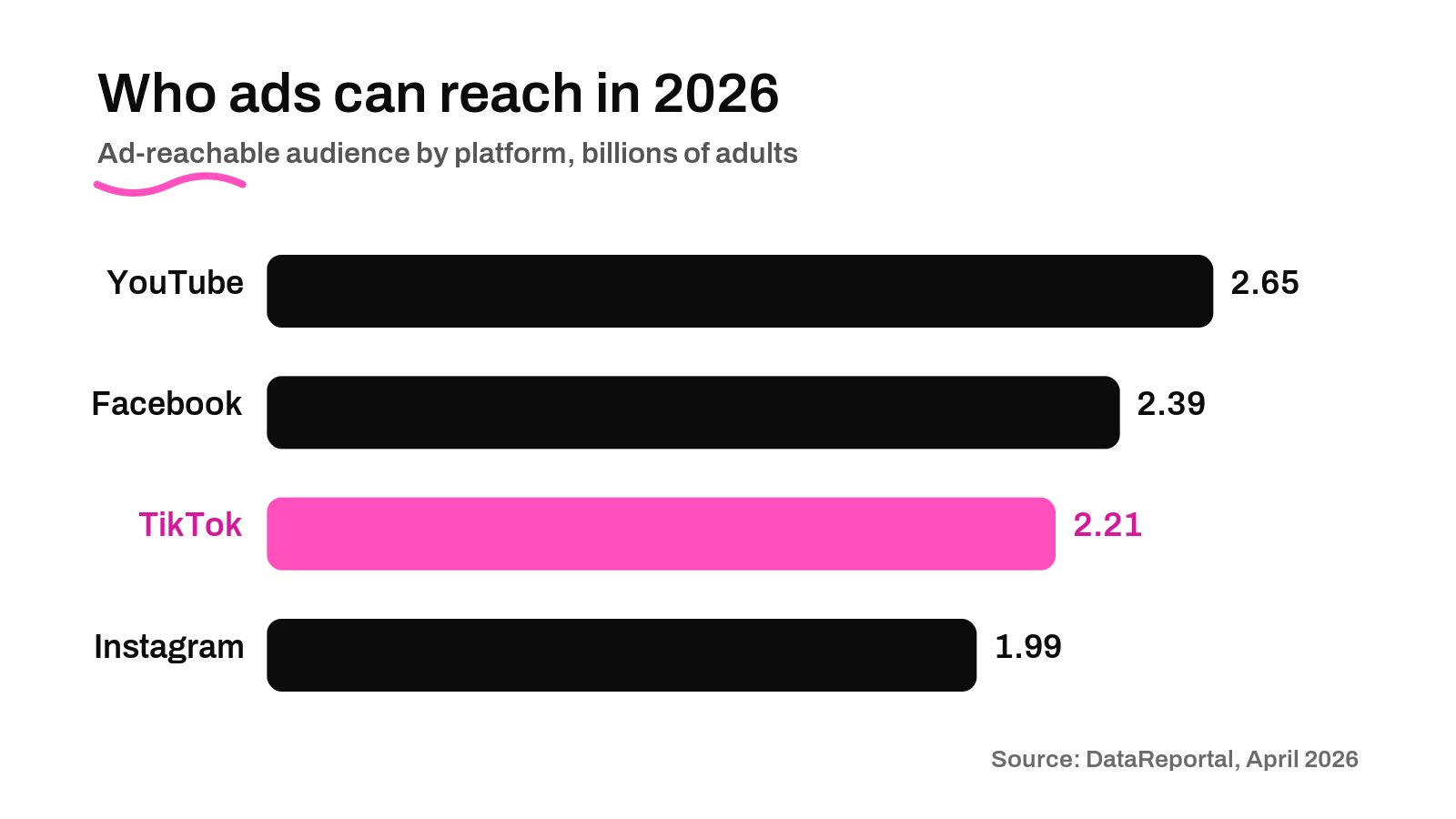
TikTok has more than 3.5 billion monthly active users worldwide, a figure disclosed via ByteDance investor Sofina in 2026. For advertising purposes the practical number is smaller but still vast: TikTok’s own planning tools report an ad-reachable audience of 2.21 billion adults, which puts it third among all social platforms, behind YouTube (2.65 billion) and Facebook (2.39 billion) and ahead of Instagram (1.99 billion) (DataReportal, April 2026).
The platform’s US future, the one genuine cloud over those numbers, cleared in January 2026 when ByteDance completed the deal moving TikTok’s US operations into a majority American-owned joint venture led by Oracle, Silver Lake and MGX, securing the app for its roughly 170 million American users (CNBC, 2026). Growth has not slowed while the lawyers worked: TikTok topped worldwide app downloads again in 2025 (Sensor Tower, 2026).
TikTok users in the UK: the numbers that matter
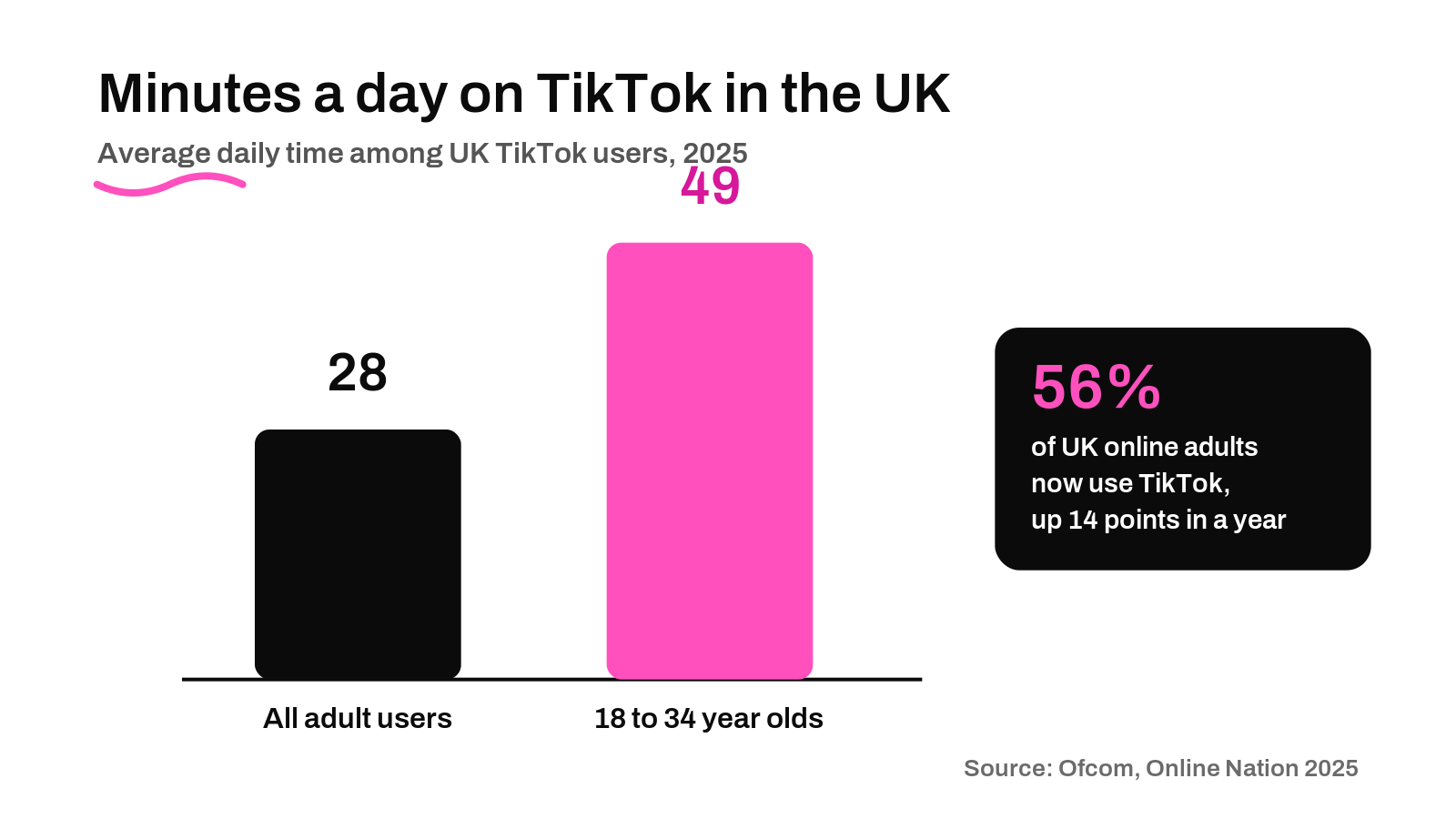
The UK data is the part most global stats pages skim, and it is the part UK brands actually need. DataReportal counted 26.8 million adult TikTok users UK-wide in late 2025, with ad reach up 2.96 million (+12.5%) in a year (Digital 2026). Ofcom’s Online Nation 2025 study puts TikTok at 56% of UK online adults, a 14 percentage point jump year on year, the fastest riser among the big platforms.
Time spent is where TikTok really separates itself. UK adult users average 28 minutes a day on the app, and 18 to 34 year olds average 49 minutes (Ofcom, 2025). For comparison, UK adults average 51 minutes a day on YouTube across all devices (Ofcom, 2025), on a platform people have used for two decades. TikTok built its daily habit in a fraction of that time.
TikTok is also quietly becoming part of the UK’s news diet: 10% of UK adults now use it as a news source, rising to 29% among 16 to 24 year olds (Ofcom, News Consumption in the UK 2025). Whatever you think about that as a citizen, as a marketer it means the platform is not just entertainment inventory. It is where a chunk of the country finds out what is going on.
TikTok demographics: who is actually on it
The lazy read on TikTok demographics is “it’s just teenagers”, and the data retired that one a while ago. In the US, 37% of all adults now use TikTok, up from 21% in 2021, and roughly half of 18 to 29 year olds are on it at least once a day (Pew Research Center, 2025). Most US teens use YouTube and TikTok daily (Pew Research Center, 2026). In the UK, the adult audience skews female: 61.5% of TikTok’s UK ad-reachable adults are women (DataReportal, 2026).
Our take, from inside client campaigns: the fastest-growing pockets of TikTok are the unglamorous ones. Parents, tradespeople, finance nerds, gardeners. The teenager stereotype is a decade out of date, and briefs written against it keep missing the actual audience. Check who your category’s communities are before assuming you are too grown-up for the platform.
TikTok usage statistics: the attention numbers
However you cut the TikTok usage statistics, the app’s defining feature is how long it holds people. Android users worldwide average close to 35 hours a month in TikTok, the highest of any major social app and well clear of YouTube’s roughly 27 hours (DataReportal / data.ai, 2025). TikTok also led the world on total time spent in-app across 2025, not just downloads (Sensor Tower, 2026).
That attention is why the ad money followed. US TikTok ad revenue is forecast to pass 17 billion dollars in 2026 (eMarketer), and if you are wondering what buying some of that attention costs, we broke down formats, benchmarks and budgets in our TikTok advertising guide. The short version: the attention is still under-priced relative to where the eyeballs are, and it will not stay that way forever.
Engagement statistics: TikTok versus everyone else
Reach tells you who you could talk to. Engagement tells you who talks back, and this is the gap the other platforms have not closed. TikTok’s median brand engagement rate by follower is 1.73%, nearly five times the next best channel, Instagram, and its median engagement rate by view sits at 3.4% (Rival IQ, 2025 Social Media Industry Benchmark Report). Those medians come from a study of 2,100 brand accounts across 14 industries, so they describe ordinary brands, not outliers.
Two honest caveats from people who live in these dashboards. First, engagement medians fell across most platforms in 2025, TikTok included, so benchmark against this year’s number rather than a screenshot from 2022. Second, engagement rate flatters small accounts and punishes big ones everywhere. The useful comparison is you versus your category, not you versus the global median. But the league table itself has not changed: per follower and per view, TikTok is still where interaction is cheapest to earn.
TikTok search statistics: the quiet behaviour shift
The most underrated TikTok number is not about entertainment at all. 49% of US consumers have used TikTok as a search engine, up from 41% two years earlier, rising to 64% among Gen Z (Adobe, 2026). People search TikTok for recipes, reviews, how-tos, places to eat and products to buy, and they trust a real person’s 30-second answer over ten blue links more often than most brands have noticed.
The nuance in Adobe’s data is worth keeping: fewer Gen Z respondents now say they prefer TikTok over Google outright. This is not a Google funeral. It is a split search world, where discovery and “what’s it actually like” questions happen on TikTok while transactional search stays on Google. For brands the implication is mechanical: your TikTok captions, on-screen text and spoken words are now search inventory. Name the thing, say the category out loud, and check what surfaces when you search your own product on the platform. Your customers already have.
TikTok for business and shopping: the commerce statistics
TikTok’s commerce layer matters most in the UK, its most mature Shop market in Europe. More than 200,000 UK businesses now sell through TikTok Shop, from independents to household-name retailers, on a platform that only launched here in 2021 (TikTok, 2025). Globally, TikTok Shop reached around 15 million sellers by 2025 (Statista / industry estimates, 2025).
For brands using TikTok for business more broadly, the platform now runs the full funnel: discovery in the feed, search inside the app, creator partnerships, paid amplification and native checkout. The stat we find most persuasive is not a commerce number at all, though. It is that 56% UK adult reach figure. Distribution that broad, with checkout attached and the attention numbers above, is why “should we be on TikTok” has quietly become “why aren’t we”.
Why TikTok numbers never seem to agree (a sourcing note)
If you have ever seen TikTok’s audience quoted as 1.6 billion on one page and 3.5 billion on another, neither page was necessarily wrong. They were measuring different things, and knowing the difference is what stops a deck getting picked apart. Monthly active users (the 3.5 billion) count everyone who opens the app, worldwide, and come from ByteDance disclosures. Ad reach (the 2.21 billion) counts adults TikTok’s ad tools say campaigns can actually target, so it excludes under-18s and some markets. Survey reach (Ofcom’s 56%) counts people who say they use the platform, which captures lurkers the ad tools miss.
House rule for citing stats: name the source, keep the year attached, and never compare a 2022 benchmark with a 2026 one to manufacture a trend. Every figure on this page follows that rule, which is precisely why you can borrow them.
What we see from inside the platform
Independent data tells you what TikTok is. Running a channel tells you what it takes. We committed properly to our own TikTok at the start of 2026: a real plan, a shared process across the team, and TikToks planned two weeks ahead at all times. The result was 50 million views in the first three months of 2026, with no media spend behind it. When we brought creator-led TikTok thinking to Lipton’s SLURP Squad festival campaign, it reached 149 million impressions.
We share those numbers because they are the piece most stats pages cannot give you: proof that the reach in this article is actually claimable by a brand-sized account, not just by celebrities and lottery winners. The platform still hands out enormous organic distribution to whoever consistently earns the watch time (we wrote up exactly how that works in how to go viral on TikTok).
What the 2026 numbers mean for brands
Here is our honest read of everything above. TikTok in 2026 is a mainstream, majority-of-the-internet platform with the deepest attention pool in social, a maturing ad market and, in the UK, a commerce engine already carrying 200,000 businesses. The numbers no longer support treating it as a youth experiment. They support treating it as infrastructure.
For us at Sunday Treat that’s TikTok. That is our foundational platform, and then we take what works well on TikTok and we put it on LinkedIn and Instagram in a different format that is more appropriate to that platform.
 Gulliver Moore
Co-Founder, Sunday Treat
That is the strategy the statistics point to: pick your foundational platform, and if your audience is under 45 the numbers above make a strong case it should be TikTok, then adapt the winners outwards rather than spraying one export everywhere. It is exactly how our influencer and social team builds channel plans, and how our performance marketing team decides where paid budget earns its keep. The platforms will keep shuffling. The attention data updates every year. We will keep this page current, sources and all.
Putting these numbers in a strategy deck?
Keep reading: our video marketing statistics hub and TikTok advertising guide carry the wider data. And if you want a team that turns numbers into campaigns, say hello.
Get In Touch